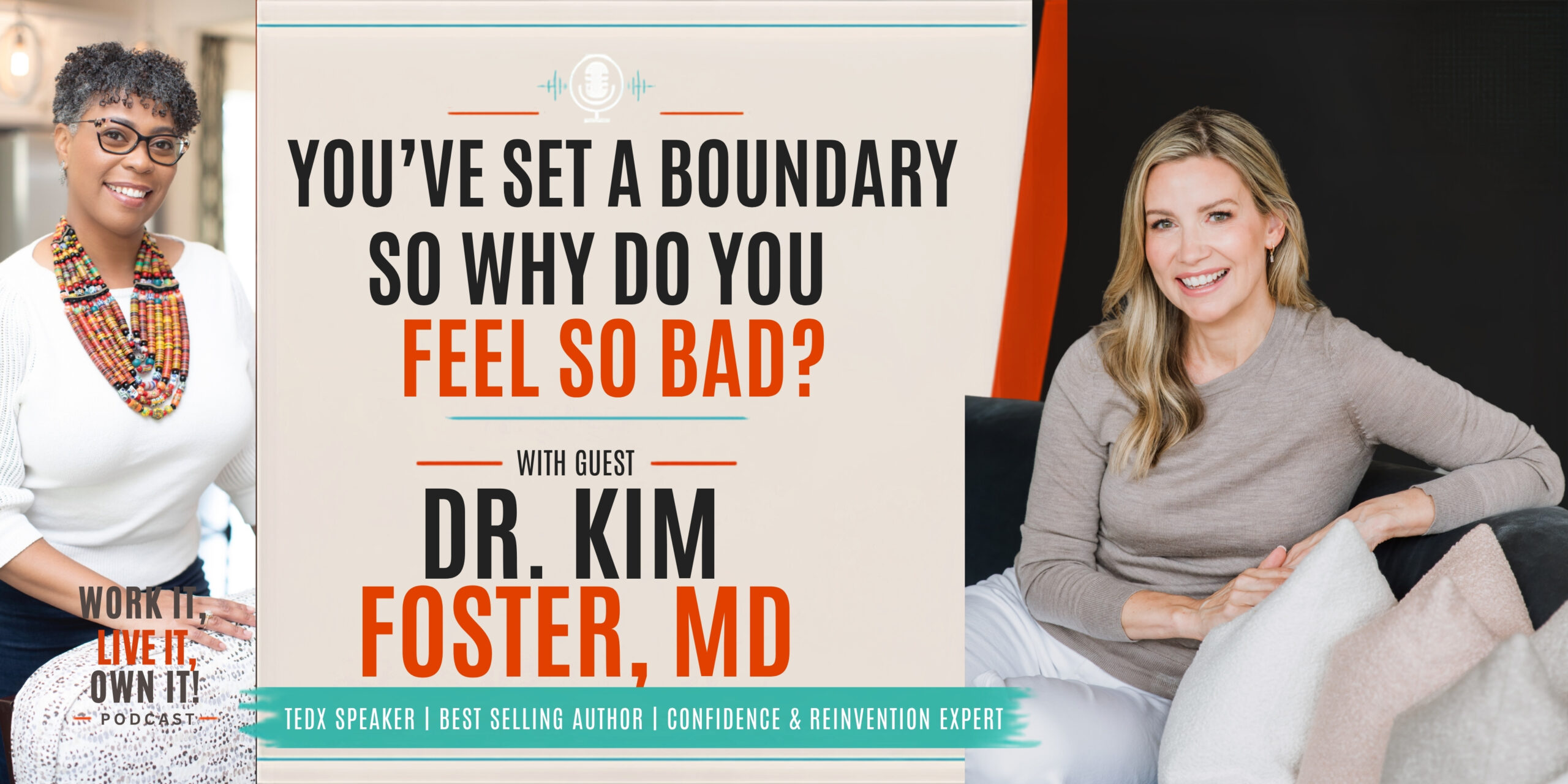
Transcript: You Set the Boundary. So Why Do You Still Feel Bad About It?
SaCola Lehr with Dr. Kim Foster | Work it, Live it, Own it! .
Timestamp: 00:01 — Welcome and episode focus
SaCola Lehr: Hello, everyone, and welcome back to another episode of the Work It, Live It, Own It podcast. If this is your first time here, welcome. And if you’re returning, you already know we’re here to take burnout and transform it into brilliance.
SaCola Lehr: Today’s episode is all about helping us understand why a healthy boundary can still induce guilt. We’re also going to introduce some tools that will help us build work/life harmony—not just a framework, but tools that will help us without abandoning ourselves.
SaCola Lehr: If you’ve ever had that feeling where you finally set a boundary, or you said no to an extra project on the weekend, you actually close your laptop, and then you spend the next two hours feeling guilty anyway, it’s not a discipline problem, and it’s not a willpower problem. And according to today’s guest, it may not even be a boundary problem. It could be an identity problem.
SaCola Lehr: Dr. Kim Foster spent 20 years as a family physician in Canada. In exam rooms, she saw smart, capable people who struggled to make changes they genuinely wanted to make: less stress, more rest, better health. We all want that, right? And she kept asking the question that many of us know personally: if we know what to do to support us and help us, why is it still so hard to do it?
SaCola Lehr: Then she had her own health crisis that became a turning point in her life. She became burned out. She became ill with a rare autoimmune disorder, and then she had to confront the story that she had been living from. That experience led her to a powerful realization: behavior is often just the surface. The inner story underneath is what can actually keep us stuck.
SaCola Lehr: Today, Dr. Foster is a TEDx speaker, founder of the Wellness Coach Academy, creator of educational wellness content, and the author of Redesigning You: Change Your Inner Story, Transform Your Health. She helps people understand that lasting change is not just about trying harder or finding another system; it’s really about recognizing the identity and beliefs shaping our choices. So welcome, Kim, to the Work It, Live It, Own It community. So glad to have you here.
Dr. Kim Foster: Thank you so much, SaCola, for that introduction. It’s a pleasure to be here. I’m excited for our conversation.
SaCola Lehr: Thank you so much. So, without further ado, let’s go ahead and dive in.
Timestamp: 02:40 — Moving upstream and a new professional calling
SaCola Lehr: You had what most people call a dream career. You were a doctor, respected in your community, stable. You were making a real difference. What was actually going on underneath that picture that most people could not see?
Dr. Kim Foster: That’s a good place to start because it was hard to understand, on the outside and on the inside. Like you said, I practiced as a family doctor for 20 years in total. There was a lot that I loved about being a doctor and practicing medicine, but at a certain point, I started to reach a stage where I realized that I wanted to help people in a different way.
Dr. Kim Foster: As a doctor, so much of what I did would come after something had already gone wrong. Somebody already had heart disease or diabetes. They were overwhelmed and stressed, and their health was really starting to suffer. I kept thinking, “I really want to move further upstream here.” I wanted to help people change their habits, the way they were thinking, and their decisions before things went wrong.
Dr. Kim Foster: At the same time, I really started to feel an increasingly strong creative pull. I wanted to create and teach and speak and write and do other things as creative pursuits within my professional life. So that’s what I started to do. I started to dabble. I started to make some YouTube videos. I started to write a little bit and pursue that feeling, that calling.
Dr. Kim Foster: I did come to realize, though, that that was the work. The side work that I was doing was really the main work that I wanted to do. But getting clear on that didn’t mean that it was going to be easy to make the transition, because that transition out of being a practicing clinical physician was really tough. By that stage, so much of my identity was deeply embedded with being a doctor. So it wasn’t easy to walk away, but I did walk away eventually, after a lot of work on that element of things. This is the work that I do now.
SaCola Lehr: Thank you so much for sharing your story and your journey, because a lot of women—a lot of people in general—struggle with that transition. You went to school for so many years to be this trained professional, and you realize that the framework of working that nine-to-five or those shifts didn’t exactly fit into what you really wanted to do, or much less actually get to the core of what a lot of people are struggling with. Thank you for sharing that part.
Timestamp: 05:28 — Health crisis and wake-up call
SaCola Lehr: Now, to dive in a little bit more personally, while also respecting your privacy, you talked about a health crisis that became a turning point for you. Can you take us back to that moment? What happened, and what did it force you to face?
Dr. Kim Foster: It was a huge turning point for me because I had been very healthy. It was not quite a year after my second son was born, and I was working as a physician. We were renovating the house that we were living in, so there was a lot of chaos and a lot of stress. I was about 10 or 11 months postpartum and was, of course, burning the candle at both ends, as we do, taking on too much and completely not prioritizing my own health, even though I absolutely knew better.
Dr. Kim Foster: It was, of course, complete hypocrisy, because I would be in my working days advising people on what they needed to do and then simply not doing it myself. Then I suddenly got very ill with a rare autoimmune condition called Löfgren syndrome, which is a variant of sarcoidosis, which itself is uncommon. It involved large-joint inflammation, skin rashes—sort of inflammatory welts—and I was really unable to move anywhere. I was stiff and inflamed everywhere.
Dr. Kim Foster: It was terrifying because I didn’t know. Autoimmune diseases are scary, and for a long time you just don’t know what they are. There was a lot of testing. I saw a bunch of different specialists before they finally landed on that diagnosis. It took weeks before they figured out what was going on. In the meantime, I was thinking all kinds of things: “Is this MS? Is this rheumatoid arthritis? What is this?”
Dr. Kim Foster: I didn’t know how long it was going to last. I didn’t know if this was my new normal. I didn’t know if I was going to be a sick mom, if I was going to be somebody who was not going to be able to live a full and normal life ever. It was terrifying, and it was a real wake-up call.
Dr. Kim Foster: In the end, of course, the official cause of Löfgren syndrome is idiopathic. Rheumatologists don’t really know what causes it. But I did have a couple of very seasoned specialists who said, “Yes, absolutely. The stress and you not taking care of yourself absolutely precipitated it.” And I knew that too. I knew that was the triggering incident. It was just too much for my system.
Dr. Kim Foster: To walk that whole thing back and heal myself and get back to full functioning and thriving again, I really had to reevaluate everything that I was telling myself about how I was taking care of myself, what I was prioritizing, and all of those pieces.
SaCola Lehr: There is nothing like a health crisis or a big pivotal turning point in our lives to really evaluate us and say, “Okay, I wasn’t doing what I was supposed to be doing.” It really makes you appreciate life. A few months ago, I was dealing with what you were dealing with, and it took months for them to figure out what my condition was. Thank you for sharing that journey.
SaCola Lehr: But you also said something very key: you knew what to do. As a physician, you knew what to do. You told and helped patients with this before, but you weren’t doing it yourself. I think we’re all guilty of that, right?
Dr. Kim Foster: Yes.
Timestamp: 09:09 — Leaving an identity without rejecting the past
SaCola Lehr: Let’s talk about leaving a familiar identity, because you mentioned that first. When you decided to leave medicine, I’m curious: the people around you—family, colleagues, friends—must have thought you were absolutely crazy for throwing everything that you worked so hard for away. How were you able to navigate that, and what did that experience teach you about the identity work that you’re in?
Dr. Kim Foster: That experience taught me so much. I learned a lot being a physician, but I especially learned a lot when I was transitioning out of medicine because you’re 100% correct, SaCola. Not everyone, but many, many people around me were really confused, concerned for me, and bewildered—all of the reactions that you can imagine. Because, yes, exactly what you said: it seems like, “Why would you throw this all away? You have worked so hard to get here, and you invested so much time and money and effort and all of those things, and now you’re just going to turn your back on it and go and do what exactly?”
Dr. Kim Foster: Starting to run an online business, being a YouTuber—those things do not exactly carry the same level of credibility and status as being a doctor, and we all know that. Trust me, I had all of those same questions for myself too. It wasn’t just people saying these things to me. I was absolutely circling around with, “Am I crazy? Why do I want to change this? What is going on? Maybe I just keep sticking it out.”
Dr. Kim Foster: What I came to understand after doing a lot of work on this and taking some very specific steps was that, when I thought back to when I was 17 and decided that I wanted to be a doctor and was going to put myself on that pathway, I didn’t want to do it to limit my options. I didn’t get that education and spend all those years and all the money and everything so that I could only be in this one box forever and ever.
Dr. Kim Foster: I could not have foretold that I was going to reach a point where I was ready for a different chapter and a different way of functioning in the world professionally, but that’s what happened. Did I need to be continually held hostage by my education? What I had to do was let it be a foundation, not a cage.
Dr. Kim Foster: The really important thing about that identity and everything that came before it is that I realized I wasn’t throwing it away. That phrase definitely came to me. A lot of people would reflect that to me, and I had it in my head: throwing it away. But I wasn’t throwing it away, because those years practicing medicine—and I ultimately practiced for 20 years—deeply shaped who I was.
Dr. Kim Foster: All the education, my training and residency, all of my experiences with patients, the way that I think, the patterns that I recognize, the way that I interact with people—I still get to bring that with me and use it in a completely different way. That is often what I talk to people about when they are undergoing a major transition, which usually involves a big identity overhaul: you don’t have to self-reject. You don’t have to erase and turn your back on everything that has come before. It has absolutely shaped who you are, and now you get to choose who you’re going to be in your next chapter, who you are going to be going forward. It doesn’t mean that all of that other stuff was a waste of time. It’s not. You get to bring it with you.
SaCola Lehr: Thank you, Kim, for letting us know and giving us some insight on that, because a lot of people struggle with the messy middle. They really, truly do in that transition. I’m pretty sure that transition did not happen overnight. Just out of curiosity, how long did it take you to transition from being a family physician into what you’re currently doing now?
Dr. Kim Foster: Like I said, I started dabbling. I started trying things out and running some experiments to see what I actually wanted to do instead while I was still practicing. That was definitely the messy middle that you refer to, because I had one toe in this world, one toe in this world, and I really wasn’t sure. I was undecided about whether I was going to completely leave medicine or just try to do a combination.
Dr. Kim Foster: I remember there was one day in the clinic where I was working at a university clinic, and I had just finished stitching up a patient’s hand. It was a little bit more complicated than usual, and I had a few minutes before my next patient, so I wanted to clear my head. I went out for a walk in the woods. This was a university clinic, and it was on campus, and there was a wooded area behind it. So I stepped out and went for a walk and listened to some music.
Dr. Kim Foster: I realized as I was walking, it just absolutely hit me: “I do not want to go back.” And I didn’t mean, “I don’t want to go back today, this afternoon.” I did not want to go back at all. I wanted to walk out of the woods, out to the other side, and just emerge into this new chapter. It was fascinating because it wasn’t on the heels of a bad day. I had actually done a pretty good job. I was competent at what I had just done. I was stitching up somebody’s hand, but I still didn’t want to go back.
Dr. Kim Foster: I knew that was when it was time for me to get out of this dabble mode, where I was half in, half out, and actually make a plan to exit. From that point to when I actually handed in my official resignation, completely walked away, and had my last patient, that took about a year. Even though I knew what I had to do, I still was struggling with the whole, “Who would I be if I wasn’t a doctor? What would this look like? What do I write on forms when it says ‘profession’?” There were a lot of other, more complicated, deeper pieces. It took me a while to really get everything in place to walk away.
SaCola Lehr: Thank you for sharing that, because I want people—and our audience—to understand: transitions take time. In a world where we’re so used to changing everything at a click of a button, especially in our age with AI, we want things to happen quickly. We want things to happen so fast. Thank you for sharing that. It’s going to take time, guys.
SaCola Lehr: I also love the fact that you said you went for a walk in the woods. You actually took a break. That’s key, because sometimes our most profound moments happen when we’re doing something where we’re actually calm—taking a walk. We could even be taking a shower or washing our hair, something so routine where our minds actually get to activate and say, “Hey, this is the path that I want to go on. This is the path that I want to walk on.”
Timestamp: 16:20 — Habits, identity, and the inner story
SaCola Lehr: Now, to transition a little bit into the identity work that you do, your work begins with the idea that it’s not our habits that need to change first. There are so many people who talk about habits, right? Your premise is that it’s not our habits that need to change first, but our identity. Can you explain to our audience, or those who are listening who might have tried every planner, morning routine, and boundary-setting tip but keep returning to the same patterns?
Dr. Kim Foster: This is the heart of all of the work that I do now. I saw this pattern over and over again through thousands of patient interactions: people who really wanted to change things or had tried to change things. The people that I saw in my office had a lot at stake. They were often sick. We’re talking life-and-death issues many of the times. But even for more routine things, I got so curious about why people are motivated, capable, intelligent, have all the information, and still struggle to make those changes.
Dr. Kim Foster: I love habits. I think habits are a great structure. They are a great system for implementing things and getting them into your daily life. I’m a big fan of that. But it is still just at one level, because it’s at the action, behavior level. If you are trying to take an action, do a habit, or change your behavior, but you don’t actually address who you believe yourself to be fundamentally at your core, then ultimately your behavior is going to start to gravitate back to who you believe you are. That is just how our minds like to work.
Dr. Kim Foster: Our minds are very comfortable with who we believe we are, and we’ve acquired that identity through a variety of sources: things that people have told us, the culture that we’re in, what parents say, what teachers say, the experiences we have had, and what we have proven to ourselves, often repeatedly. That collects and creates this sense of, “I’m this kind of person. I’m not that kind of person.”
Dr. Kim Foster: If you have an identity story that you tell yourself, like, “I’m terrible with money,” or, “I’m not really disciplined,” or, “I am the responsible one always,” or, “I take care of everyone else,” or whatever story it is about the kind of person that you are, you can try to act against that for a little while. You can try to stack some habits, set reminders on your phone, and do all kinds of action steps. But if you don’t really address who you believe you are underneath, ultimately that action, habit, and behavior is going to crumble because it is in conflict with who you believe you are.
SaCola Lehr: It’s true. Some people call it a mindset shift, but I think it’s so much more than just a mindset shift. You really have to delve into who you are as a person, getting to know ourselves. It’s such a busy world and society, we don’t really take the time to identify who we really, truly are at the core.
Dr. Kim Foster: Absolutely. We state and make these identity statements as though they’re neutral, as though they’re a universal truth, like we’re just describing our eye color or how tall we are. We say stuff about who we are: “I’m bad with tech,” or, “I’m the one that everyone depends on.”
Dr. Kim Foster: Sometimes those identity statements can actually be quite positive, and they have helped us, perhaps in a different season in life, to survive or to belong or to feel safe. It’s not always a bad, disempowering identity. But at a certain point, any identity label can start to become restrictive because it keeps dictating what you actually do. It dictates what choices you make and how you live your daily life. It becomes an instruction manual that you didn’t realize was written for you, and you just keep operating from that.
SaCola Lehr: Love it. That leads us into the inner story, because you use the phrase “inner story.” What does that mean in practical terms? How can someone begin their inner story, especially if they have been moving so quickly that they’ve rarely had time to even listen to themselves?
Dr. Kim Foster: We all do have an inner story, whether we realize it or not. Sometimes I use the term “inner blueprint” also, because we design from that. It’s how we create the structure of our lives. The very first step is to recognize it, to really start to recognize that we have been operating from this story.
Dr. Kim Foster: We often place the blame on external circumstances, things that are out of our control, and we give away our agency in that way. But recognizing that we have actually been operating from an inner story, an inner blueprint that is not serving us anymore—it might have served us at one point, but it’s not anymore—is important.
Dr. Kim Foster: It can be changed because, unlike your genetic blueprint, which is set and all your cells have it and it’s the way that you’re born, your inner blueprint is one that you have acquired and written over time throughout your life. Because it was created, it means that it can be recreated, as long as you’re aware that it actually is the source code underneath everything. It’s the operating system.
Dr. Kim Foster: If you recognize it, then you can start to question it, and then you can start to choose a more empowering identity that you would prefer to step into—one that is actually going to support you on your next-level goals.
SaCola Lehr: I like that. It all starts with a good, solid foundation.
Dr. Kim Foster: Yes.
SaCola Lehr: That inner blueprint, that inner story, is essential for anything that we want to do in life, in any season. I like that.
Timestamp: 23:15 — The dependable-one identity
SaCola Lehr: Can you share a message for the woman who is tired? There could be people listening right now who are carrying a great deal. They’re exhausted because rest never seems to restore them. What would be one thing you want them to understand that they probably haven’t heard before?
Dr. Kim Foster: Especially that archetype is an incredibly common one, and I lived it. We all know that feeling, and many of us are living it now: prioritizing everyone else, taking care of everyone else. It can be really easy to feel like a victim to all of those circumstances, but I want people to pause and question: what is the identity story underneath that?
Dr. Kim Foster: Many of us have an identity story of, “I’m the dependable one. I’m the one who everyone can count on. I’m the one who everyone can lean on. I am always there for people who need me.” That is a good thing. That’s a beautiful thing. But taken too far, it is, of course, going to mean that you are not prioritizing yourself at all and you’re going to be putting everyone else first.
Dr. Kim Foster: That’s because you have that as your operating principle. It’s your instruction manual. Subconsciously, you’re continuing to choose that. Often it’s because, like I said, we know who we are when we are in that role. It feels safe. It feels comfortable. People around us are happy with us occupying that role in the world and holding on to that identity.
Dr. Kim Foster: Trying to do something other than that—trying to prioritize yourself instead of other people’s needs—is going to feel incredibly uncomfortable. You can try to set a boundary, but it’s going to feel like there’s constant friction in your mind because it’s directly going against who you believe yourself to be at your core. We are incredibly loyal to our existing sense of self.
Dr. Kim Foster: On one level, you can absolutely be aware: “I want to change this. I need to start taking care of myself.” But deep down, if you really believe that you’re the one who everyone counts on, there is going to be friction all the time when you are trying to act against that core sense of self.
Timestamp: 25:44 — Bridge identities and building proof
Dr. Kim Foster: The key really is to start to choose a more empowered identity, one that you can actually start to build some proof for—something that you can start to prove to yourself that you actually can be. Sometimes creating that completely opposite or completely different identity is going to be a stretch too far. Your mind is going to reject that outright.
Dr. Kim Foster: What I often advise people to do is create a bridge identity. Rather than going from, “I prioritize everyone else,” to, “I take perfect care of myself at all times, always,” or something too extreme that your mind is going to reject completely, choose something that is just one step off. It’s a stretch, it feels a little uncomfortable, but it’s probably more doable.
Dr. Kim Foster: You might say, “I am someone who’s learning how to prioritize myself. I am someone who is becoming more important to myself,” or something like that. You’re choosing something that’s a bit more of a bridge, and then you go out and prove that to yourself. Keep those promises to yourself. Set one little goal in the day for how you can show up as that person that day, do it, and then reflect back on it at the end of the day, or whenever, and say, “Yeah, actually I did do that. I can keep that promise to myself.”
Dr. Kim Foster: Over time, as you do that, that’s when your new identity starts to stabilize, because you wake up and say, “Actually, I am a person who’s learning how to take care of myself,” because we’ve got so much evidence for the old way. We need to start to build proof for the new way.
SaCola Lehr: I like that, because I liken it to going to the gym. At the beginning of the year, everybody is flocking to the gym because they’ve created all these New Year’s resolutions. I learned to stop creating New Year’s resolutions and just have one word of the year that is my primary focus. How can I show up? What things can I do to produce evidence that this is happening?
SaCola Lehr: I always go back to that one word and say, “Hey, I just did something that aligns with that one word of the year.” So I like that: setting something that’s small and intentional, but also achievable, to provide that evidence and proof. Our brains are wired for comfort, so if we’re providing new proof that we’re changing and transitioning, that’s a great way to create a new framework or a new blueprint—your new inner story.
Timestamp: 28:20 — Starting with awareness
SaCola Lehr: What is one thing, though, that someone can do today? Not a system or a program—just one honest step to begin shifting the inner story that may be keeping them stuck.
Dr. Kim Foster: I really think that the very first step is just to recognize what story you’re telling yourself. For so many of us, it is unconscious. It’s behind the scenes. We’re not even really aware that it is our story. Just get really quiet and honest with yourself.
Dr. Kim Foster: Journaling is a tool that I love, and that helped me quite a bit. With my journal, I think, “Who am I being in this moment? What identity is calling the shots here? What identity is creating my reality? What identity am I making my decisions from?” Honestly, that is the spot where most of us start.
Dr. Kim Foster: We say these things as though they’re unchangeable: “I’m not an exercise person. I’m a meat-and-potatoes guy.” We say these sentences, and usually they’re the throwaway ones. We just say them because they’re not even worth examining, because everybody knows that this is true. “This is how I’ve always been. This is how I’m always going to be.”
Dr. Kim Foster: When you catch yourself making those kinds of statements that sound like truth, pause right there and ask yourself, “Okay, where did that come from? Who says that that’s true? Is it possible that something else could be true for me?” That’s where I would start.
SaCola Lehr: I like that. Even asking yourself, “Is that even a helpful thought?” A lot of times, like you said, “Oh, I’m just a meat-and-potatoes guy. That’s who I am.” I hear that all the time, even growing up. We have to be aware when we hear those things. We have to catch ourselves, because I’ve heard it as a kid: “Well, I was born this way. I’ll die this way,” things of that nature.
SaCola Lehr: That’s not always true, because we evolve and we change. I love the fact that you are helping people create that inner story and that blueprint, because we do change and evolve, and we need to figure out who we are in that moment.
Timestamp: 30:30 — Where to connect with Dr. Foster
SaCola Lehr: Now, Kim, before I let you go, first and foremost, I want to thank you so much for making this work not only practical, but personal. Can you please tell the Work It, Live It, Own It community where we can connect with you and where we can learn more about Redesigning You?
Dr. Kim Foster: My website is really my home base for everything, and it’s drkimfoster.com. I’ve got links to my book, Redesigning You. You can purchase Redesigning You everywhere books are sold, in Kindle, hardcover, or audiobook. I recorded the whole audiobook myself, which was a really fun process. If you like to listen to books, like me, then that’s always a good place to start.
Dr. Kim Foster: In terms of where I also show up, share my content, and create content, that’s on YouTube. I create a new YouTube video every week, and that’s where I love interacting with people. I have a pretty active community of commenters. I’m just about to hit 300,000 subscribers, which I’m really excited about. YouTube is my happy place too, so come on over and check out my content there.
Timestamp: 31:41 — Closing reflection
SaCola Lehr: Yes, absolutely. To close out, we’re going to make sure that we put all the links down in the show notes below so you can stay in touch with Kim. If anything you take away from our conversation today is that the reality is we can set a boundary, we can even say no, we can protect our time, our health, and the people we love, and still feel guilty afterward.
SaCola Lehr: But that guilt doesn’t mean it’s automatically going to go away. It doesn’t mean that the boundary is wrong. It may just be an invitation to notice the inner story beneath the discomfort, and that story that says, “Hey, we have to be available to be valuable.” Or you may recognize that inner story saying, “Hey, carrying everything to be dependable or earn the right to rest.”
SaCola Lehr: Any person who is listening, realize that you don’t have to abandon yourself to prove that you care. You can pursue goals and dreams that are on your heart while also honoring your well-being and your family, in whatever season you’re in. Take the time to learn how to create your inner story and your blueprint.
SaCola Lehr: If this conversation gave you something to reflect on, share it with someone else who may need that reminder. Be honest and set honest boundaries, not just for others, but for yourself. Realize that when you’re doing too much, it might be time for you to take a step back and create that inner story.
SaCola Lehr: Please be sure to follow, rate, and leave a review on the Work It, Live It, Own It podcast. Most importantly, I want you to remember that rest is not a reward for exhaustion. It is a requirement for brilliance. So until next time, guys, keep working it, living it, owning it in your everyday lives.