
Guilt after setting boundaries is common, and it does not automatically mean you made the wrong choice. Sometimes the discomfort is a sign that a healthy decision conflicts with an old identity story, especially the belief that you must always be the dependable one.
You finally said no.
Maybe you declined the extra project, protected your weekend, turned off your laptop, or told someone you could not take one more thing on. The boundary itself may have been clear. Yet afterward, the guilt arrived.
You replay the conversation. You wonder whether you disappointed someone. You feel tempted to over explain, soften the boundary, or take the responsibility back.
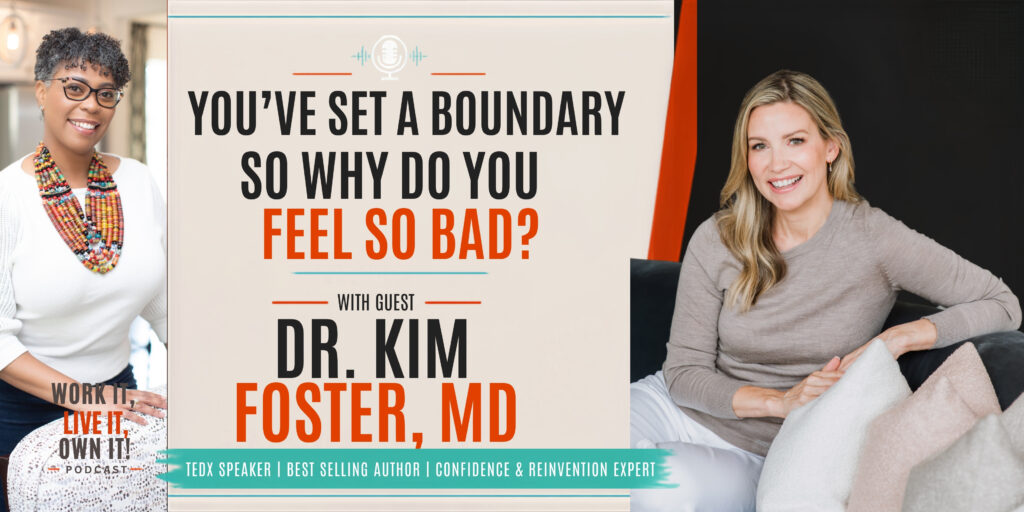
In my conversation with Dr. Kim Foster, a former family physician, TEDx speaker, identity-based transformation expert, and author of Redesigning You: Change Your Inner Story, Transform Your Health, we explored why a healthy choice can still feel so uncomfortable.
Her perspective takes us beneath behavior and into the identity stories that shape our choices.
Why guilt after setting boundaries can feel so strong
Many women already understand the basics of setting a boundary. They know their health matters. They know their schedule has limits. They know that being available to everyone, all the time, eventually costs them something.
The challenge often comes after the boundary is set.
Dr. Foster explained that behavior tends to return to the identity we believe at our core:
“Your behavior is going to start to gravitate back to who you believe you are.”— Dr. Kim Foster
If your inner story says, I am the one everyone depends on, then protecting your time can feel like more than a practical decision. It can feel like you are becoming someone you are not allowed to be.
That is why boundary guilt can feel so strong. You are not simply changing a calendar entry. You may be stepping outside a role that once helped you belong, feel safe, or be valued.
If the guilt arrives as a morning-after urge to take back what you said, read why asking for help can feel so vulnerable. That reflection explores the vulnerability hangover that can follow an honest request or a healthy limit.
When “the dependable one” becomes too expensive
Being dependable is not a flaw. It can be a beautiful strength. It may be part of how you lead, care for your family, build trust, and move through difficult seasons.
But every strength needs room to breathe.
When “the dependable one” becomes your only identity, self-protection can begin to feel selfish. You may accept responsibilities that don’t fit. You may postpone rest until your body forces you to pause. You may believe you have to be available in order to be feel valuable.
Dr. Foster describes those identity labels as an instruction manual we may not realize has been written for us. It can quietly direct what we accept, how we respond, and the care we believe we are allowed to receive.
If you are accustomed to being the person everyone relies on, this reflection on feeling unsupported while carrying so much offers another place to begin.
The answer is not to care less. The answer is to create an identity that makes room for you, too.
Let your past be a foundation, not a cage
Dr. Foster’s own career transition makes this message personal. After 20 years as a family physician, she felt called to help people earlier in the process, before stress and exhaustion became a crisis. Leaving clinical medicine was not an overnight decision. It required her to consider who she would be beyond a title that had shaped so much of her life.
Her reframe is one to carry into any new chapter:
“I had to let it be a foundation, not a cage.”— Dr. Kim Foster
Your past is not something you must erase in order to grow. Your education, experience, wisdom, and hard-won lessons can come with you. They can support what is next without deciding every choice you are allowed to make now.
A bridge identity is a practical next step
Changing an identity can feel overwhelming, especially when you have spent years proving the old one to yourself and everyone around you.
Dr. Foster offers a more compassionate next step: a bridge identity.
Instead of trying to jump from “I put everyone else first” to “I take perfect care of myself at all times,” choose language your mind can begin to believe:
I am someone who is learning how to prioritize myself.
Then build proof.
Keep one small promise to yourself today. Take the walk you said you would take. Leave work when you said you would leave. Take the lunch break. Make the appointment. Let that action become evidence that you can trust yourself.
Over time, those small choices support a new inner story.
A question to carry with you
When guilt comes after a boundary, pause before you respond to it. Ask yourself:
Who am I being in this moment? What identity is calling the shots here?
The first step is not to judge the answer. It is to notice it with honesty.
Listen to the conversation
Listen to “You’ve Set a Boundary. So Why Do You Still Feel Bad?” with Dr. Kim Foster for a compassionate conversation about identity, guilt, self-protection, and work-life harmony.
Frequently asked questions about boundary guilt
Why do I feel guilty after setting a boundary?
Guilt after setting boundaries can happen when a healthy choice conflicts with an identity story, such as believing you must always be available, helpful, or dependable. The discomfort is worth noticing, but it does not automatically mean that the boundary was wrong.
Does guilt mean my boundary is wrong?
No. Guilt can be a signal to reflect, but it is not proof that your boundary is unkind or unreasonable. Consider whether your choice protects your time, health, values, or commitments. If it does, the discomfort may be part of practicing a new way of relating to yourself.
What is a bridge identity?
A bridge identity is a believable next-step statement that helps you practice a new pattern without demanding a total reinvention. For example, “I am someone who is learning how to prioritize myself” may feel more possible than trying to become perfectly self-protective overnight.
How can I set boundaries without guilt?
The aim is not necessarily to eliminate guilt immediately. Start by noticing the thought behind it, choose one bridge identity, and keep a small promise to yourself. Each aligned action becomes evidence that you can care for others while also including yourself in the care.
About Dr. Kim Foster

Dr. Kim Foster is a former family physician, TEDx speaker, identity-based transformation expert, and author of Redesigning You: Change Your Inner Story, Transform Your Health. Visit Dr. Kim Foster’s website for her work and current resources. You can also find her educational content on YouTube.
If this message gave you language for something you have been carrying, share this article with the woman in your life who is known as “the dependable one.” She may not need permission to care less. She may need permission to include herself in the care.