self-care

  • How to Rest Without Feeling Guilty: 3 Proven Steps to Reclaim Your Peace

    Here is a truth that might make you uncomfortable: rest is not a reward for exhaustion. It is a requirement for brilliance. If you are treating rest like another metric to conquer, or a luxury you have to earn by completely emptying your tank first, you are not resting. You are just recovering from burnout. To move from burnout to brilliance, you must learn how to rest without feeling guilty.

    For women who are used to driving results, managing households, and leading teams, the concept of doing nothing feels entirely foreign. We have been conditioned to believe that every minute must be productive. So, when we finally do take a break, we turn rest into a project. We read self-improvement books on the beach. We listen to industry podcasts while we run. We use our weekends to meal prep, organize the garage, and catch up on emails. We are “resting” our bodies, but our minds are still running a marathon.

    The problem is that this kind of optimized downtime does not restore us; it just changes the scenery of our exhaustion.

    Listen to the full episode of Work it, Live it, Own it! here

    The Trap of Optimized Downtime: Why You Can’t Rest Without Feeling Guilty

    Why do we do this? Because stillness feels dangerous when your entire identity is built on being capable and productive. If you stop moving, you might have to sit with the exhaustion you have been outrunning. Society tells us that our value is tied to our output. So, we feel guilty when we are not producing. We believe that if we are not constantly moving forward, we are falling behind. This mindset turns rest into a source of anxiety rather than a source of renewal, making it nearly impossible to rest without feeling guilty.

    I know this cycle intimately. I remember taking my first real beach vacation in years. I was supposed to be unplugging. But instead of listening to the ocean, I spent the first three days sitting under an umbrella with a notebook, furiously outlining my goals for the next quarter. I was so terrified of losing momentum that I could not even let myself enjoy the sand. I was physically on vacation, but mentally, I was still in the office.

    It was not until I realized that my inability to rest was actually sabotaging my brilliance that I knew something had to change.

    Navigating Your Boundaries Around Rest

    This brings us to the “N” in the PRONE to Power framework: Navigating Boundaries.

    Navigating boundaries is not just about saying no to other people; it is about saying no to the voice in your own head that tells you to keep working when you are supposed to be resting. It is about creating a boundary around your downtime and fiercely protecting it from the infiltration of productivity.

    If you are reading this and realizing you have not actually rested in years, that you have just been recovering from exhaustion so you can go back to producing, I want you to know: that realization is heavy. You are not broken for not knowing how to stop. You were trained to be this way by a world that profits from your endless output.

    But you are allowed to stop producing. You are allowed to have time that belongs to absolutely no one, not even your own self-improvement goals.

    Your Action Step: Learning How to Rest Without Feeling Guilty

    This week, I want you to give yourself fifteen minutes of completely unproductive time. No podcasts. No planning. No organizing. Just sit. Stare out a window. Drink your coffee without scrolling. When the urge to “do something useful” hits you, just notice it, and stay seated. Just fifteen minutes. This small window is your first step in practicing how to rest without feeling guilty.

    Remember, you can accomplish your goals and dreams without forsaking your family, your health, and your well-being. True brilliance requires genuine rest. It is time to move from burnout to brilliance.

    Listen to the full episode of Work it, Live it, Own it! here

    Ready to dive deeper? Grab your copy of Harmony Hustle for Women: Master the Art of Thriving in Life and Career on Amazon: Purchase Here

  • Are You Running on Empty? How to Break the Burnout Cycle & Reclaim Your Life

    Do you feel like you’re constantly juggling too many tasks, putting out fires, and meeting everyone’s needs but your own? If the words “I’m okay, I’ll handle it” are your go-to responses, you might be caught in a dangerous cycle of burnout that’s silently draining your energy, joy, and sense of self.

    In our latest podcast episode, “Break the Burnout Cycle: Set Boundaries & Reclaim Your Time,” we delve into why many of us, especially self-reliant women, often wear exhaustion as a badge of honor and how to break free. This isn’t about radical, overnight change: it’s about making small, intentional choices that lead to profound transformation.

    Listen to the Full Episode Below

    The Three Hidden Energy Drainers

    Burnout doesn’t happen overnight. It’s a slow leak, often caused by three hidden energy drainers that we mistake for strengths:

    1. Fear of Confrontation: You avoid difficult conversations to keep the peace, but the unspoken needs and resentment build up, creating a heavy emotional weight. Every time you swallow your truth, you’re telling yourself that your needs don’t matter.

    2. Misguided Optimism: You hope that if you just keep pushing, someone will notice and step in to help. But this magical thinking often leads to disappointment and loneliness, leaving you feeling invisible and unappreciated.

    3. Persistent Availability: In a hyper-connected world, being “always on” has become the norm. You answer emails at all hours, never miss a call, and make yourself constantly available to everyone. This leaves no room for mental rest, leading to decision fatigue and chronic exhaustion.

    “Sucking it up and going alone isn’t a badge of honor. It’s a recipe for exhaustion, resentment, and burnout.”

    From Surviving to Thriving: 4 Steps to Reclaim Your Power

    Breaking the cycle of burnout isn’t about becoming a different person. It’s about making space for yourself, one small choice at a time. Here are four actionable steps you can take today to start reclaiming your energy and wellbeing:

    1. Get Honest with Yourself Through Journaling

    You can’t change what you don’t acknowledge. Dedicate just 10-15 minutes each day to journaling. Write down where you feel stretched thin, what conversations you’re avoiding, and where you’re overextending yourself. This isn’t about judgment; it’s about gaining clarity. Once you see the patterns on paper, you can start to address them.

    2. Speak Your Truth to Someone You Trust

    Burnout thrives in isolation. Choose one person—a partner, a friend, a therapist—and share your struggles. Voicing your feelings breaks the silence and is often the first step toward getting the support you need. You don’t need to have all the answers; you just need to be heard.

    3. Set One Small, Manageable Boundary

    Boundaries aren’t about building walls; they’re about protecting your energy. Start small. Pick one area of your life—work, home, or personal time—and set one clear boundary.

    •Work: “I will not check emails after 7 PM.”

    •Home: “I need 30 minutes of uninterrupted time for myself each evening.”

    •Personal: “I will turn my phone off for one hour before bed.”

    Communicate your boundary clearly, kindly, and firmly. Remember, you’re not responsible for other people’s reactions to your boundaries.

    4. Protect Your Energy with Intention

    Your energy is your most valuable resource. Protect it fiercely. This means scheduling non-negotiable time for rest and self-care, just as you would a critical meeting. It means saying “no” to things that drain you and “yes” to things that fill you up.

    “Thriving means setting loving boundaries that protect your wellbeing. It means speaking up for your needs with confidence and kindness.”

    Your Journey to a More Empowered Life Starts Now

    Imagine what your life could look like six months from now if you started implementing these changes today. Picture yourself leaving work at a reasonable hour, feeling present and engaged with your family, and having the energy to pursue your own interests.

    This journey is a marathon, not a sprint. Be patient with yourself, celebrate the small wins, and remember that you are worthy of a life where you feel energized, supported, and truly alive.

    Ready to dive deeper? Listen to the full podcast episode, “85: Break the Burnout Cycle: Set Boundaries & Find Your Power,” for more in-depth strategies, personal stories, and a guided path to reclaiming your life.

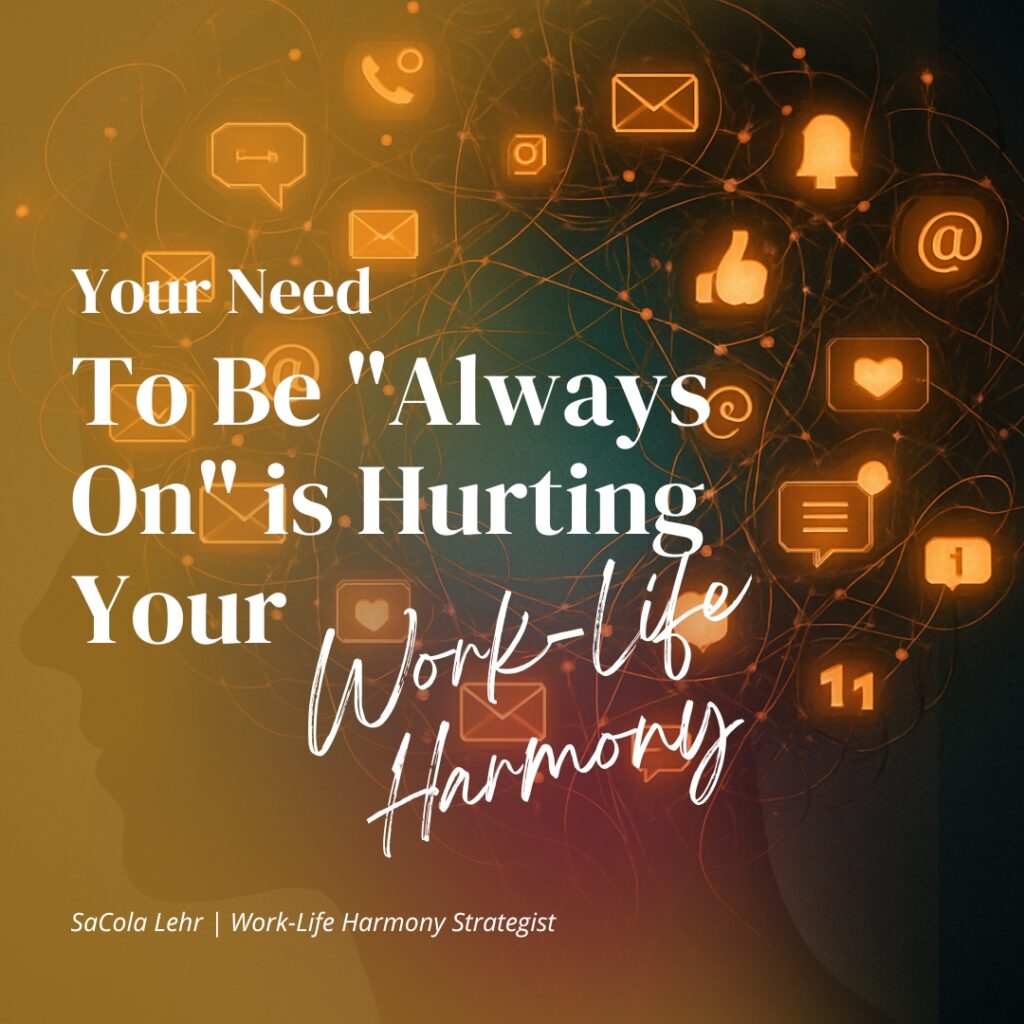
  • The Silent Burnout Trap: Why Your Need to Be “Always On” is Hurting Your Work-Life Harmony

    It’s Time to Power Down

    We live in the age of the perpetual ping.

    From the moment we wake up, our devices are screaming for our attention: Slack pings, email notifications, group texts, and the endless scroll of social media. We’ve been conditioned to believe that constant responsiveness is a sign of dedication, professionalism, and even love. If you’re not answering that email at 10 PM, are you truly committed? If you don’t reply to that text instantly, do you even care?

    This pressure to be persistently available is more than just a modern inconvenience; it’s a deeply damaging habit that is quietly draining your emotional battery. In this powerful installment of the “Suck It Up, Go It Alone” series, we’re unpacking why this need to be “always on” is not serving you, and how you can take brave action to reclaim your peace.

    The Cause of Your Hyper-Responsiveness

    The truth is, this isn’t just about technology. For many of us, the need to be constantly available is deeply rooted in our past.

    Think back. Were you the child who smoothed over tension, anticipated everyone’s needs, or felt responsible for keeping the peace? For those who grew up feeling they had to earn love or prove their value through their helpfulness, being needed became an identity.

    This is the Identity Trap: the dangerous, subconscious belief that says, “If I’m not available, I’m not valuable.”

    Let me be clear: Your worth is not tied to how quickly you respond or how many fires you put out. That survival strategy may have served you well as a child, but as an adult, it is an emotional drain that is leading you straight to exhaustion. You are valuable, period. Your availability is a choice, not a measure of your worth.

    Burnout Disguised as Dedication

    When you are constantly responding, checking, and anticipating, your nervous system is trapped in a perpetual state of “alert mode.” It never gets a break.

    This hyper-vigilance is the unseen cost of constant availability. It chips away at your peace of mind, manifesting as:

    • Irritability and Fatigue: You’re too wired to rest, and too tired to be present.
    • Resentment: You start to resent the very people you’re trying to care for and serve.
    • Emotional Exhaustion: You are the emotional glue for everyone your spouse, your kids, your parents, your team and the weight is crushing.

    We often label this constant state of “on” as dedication, but I want you to recognize it for what it truly is: burnout disguised as dedication. For some, this is even a trauma response, a hyper-awareness carried into adulthood from homes where peace was conditional on behavior.

    It’s time to stop being addicted to the chaos and start prioritizing your well-being.

    Let’s Reclaim Your Energy and Peace

    The good news is that you can unlearn this habit. You can reclaim your time, your energy, and your peace without losing your impact. It takes brave action, but the reward is a life lived in harmony, not survival mode.

    Here are four practical strategies you can implement today:

    ActionStrategyThe “Why”
    1. Set a Tech BoundaryTurn off all notifications outside of work hours. Create “no phone zones” during dinner, family time, or personal rest.To give your brain and nervous system a much-needed break from constant pings and demands.
    2. Communicate Your AvailabilityClearly state your response times. Example: “I check emails three times a day,” or “My cut-off time is 6:30 p.m. for family time.”People will respect your boundaries when they are clearly communicated and consistently enforced.
    3. Create Micro-Breaks to ResetImplement 5-minute deep breathing or stretching breaks, or a 30-minute “just sit, just be” ritual after work.These small, intentional pauses calm your nervous system and restore focus, preventing the buildup of stress.
    4. Remind Yourself of the TruthInternalize the truth: You are allowed to rest, and you are allowed to be unavailable.The world will keep spinning. Your value is inherent, not conditional on your responsiveness.

    People who love and respect you will understand your need for boundaries. When you clearly communicate your availability, you teach others how to treat you, and you give yourself permission to power down.

    The Takeaway: Persistent availability is a silent burnout trap. By taking these brave actions, you can stop trading survival mode for strategies that help you truly thrive in your career, life, and everything in between. You are allowed to rest. You are allowed to be unavailable. And the world will keep spinning.

    Listen to the full episode of Work It, Live It, Own It for a deeper dive into this topic

  • Why Suffering in Silence is Holding You Back

    So many women in the sandwich generation — balancing careers, caregiving for aging parents, and raising kids — have been conditioned to “suck it up.” We tell ourselves it’s just what strong women do: hold it all together, sacrifice our own needs, and push forward without complaint. But here’s the hard truth: that mindset is not strength; it’s survival mode. And over time, it erodes our health, our relationships, and our sense of self.

    In his book Triage Your School, Dr. Christopher Jenson highlights three main areas where stress silently takes its toll: physical health, emotional well-being, and relational health. Those areas don’t just apply to schools — they apply to every woman trying to hold too much together. Ignoring them leads to resentment, disconnection, and full-blown burnout.

    Let’s break that down:

    Physical health – Stress shows up as fatigue, headaches, or even chronic conditions. When you keep pushing through, your body eventually forces you to pay attention.

    Emotional well-being – “Sucking it up” often means stuffing down feelings. That emotional silence turns into irritability, anxiety, or numbness.

    Relational health – When you never speak your needs, the people around you can’t support you. Distance grows, and loneliness sets in.

    These costs are hidden at first, but they’re very real. And they’re the reason why silence and self-sacrifice can’t be the badge of honor we wear anymore.

    A Practical Reset

    Here are two small but powerful steps you can take this week to break the silence:

    1. Journal one area where you’ve been “sucking it up.” Maybe it’s taking on extra work at the office, caring for a parent without asking siblings for help, or agreeing to commitments you don’t have the bandwidth for. Write it down — naming it is the first step to changing it.
    2. Say it out loud to someone you trust. Share your journal entry with a friend, spouse, or mentor. Speaking the words creates connection and signals to your brain that you don’t have to carry it all alone.

    It’s not about dumping every burden at once. It’s about creating tiny cracks in the silence so your truth — and your needs — have room to breathe.

    The Bottom Line

    Dr. Jenson’s framework reminds us that no system—schools, families, or our own lives—can thrive without good staffing, communication, and resources. The more you suffer in silence, the weaker those areas become. Real strength isn’t in silence or self-sacrifice; it’s in asking for help, setting boundaries, and making sure your resources are protected so you can thrive.