The emails, family messages, appointments, work deadlines, and the task someone else forgot that somehow landed with you. When everything is asking for your attention, even sitting down to focus can be hard. Especially when the rest of the list keeps running in the background. If this feels familiar, you may not need to get better at carrying everything. You may need a clearer way to decide what needs your energy first.
Does everything have a deadline—or want your attention?
A notification can arrive right away without the task needing to be done that moment. Someone may sound stressed without you being the only person who can step in. And a task can matter without needing your full attention today. When you’re tracking work, appointments, family plans and other people’s needs, every open loop can start to feel like an emergency. You respond to what’s loudest or closest, then reach the end of the day feeling like you didn’t get to what mattered most. That doesn’t mean you’re bad at prioritizing. The work may be too much, the expectations unclear, or the support missing. Another list won’t necessarily solve that.
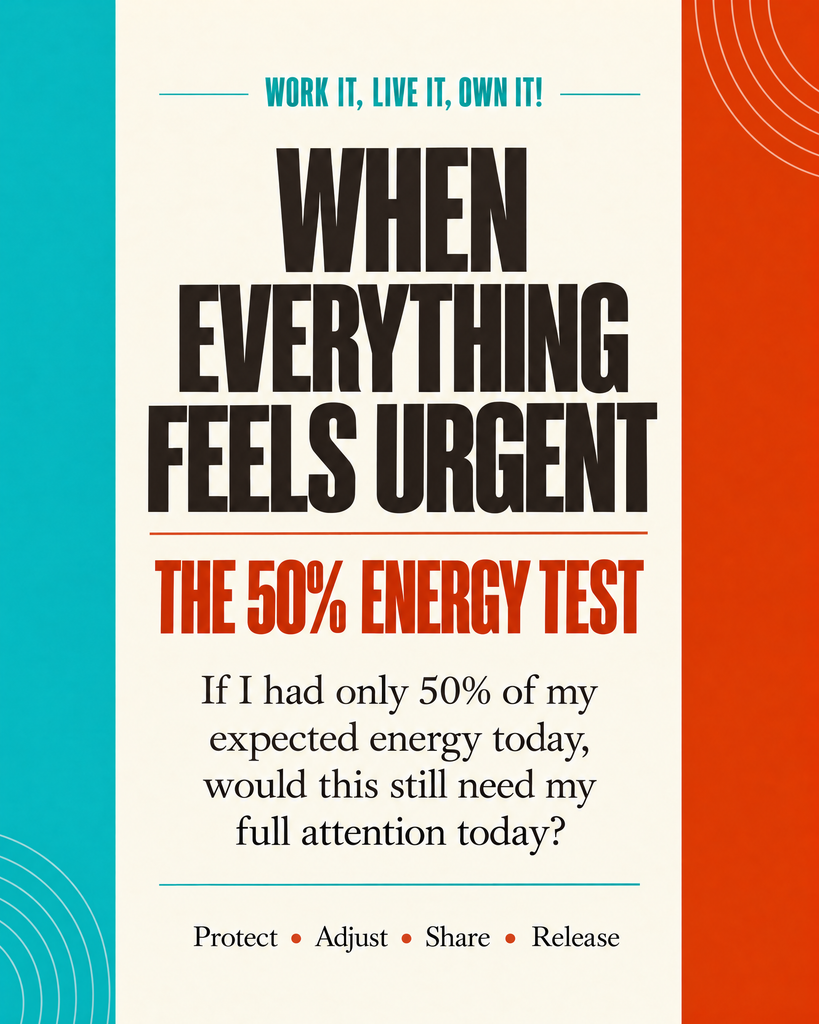
Try the 50% Energy Check-In
Choose one task that’s been taking up space in your mind. Imagine you have half the energy you expected to have today, not because you failed, but because energy changes and life happens. Ask yourself:
If I had 50% of my expected energy today, would this still need my full attention?
The question isn’t whether the task matters. Many things matter. It’s whether it needs all your attention today, given what you have to work with.
Give the task one honest category
Once you’ve picked a task, see which category fits:
Essential: Protect the core outcome, such as a meaningful deadline or a health or safety need.
Flexible: The timing, scope, standard or method could change.
Shareable: The work is real, but someone else could own a part of it.
Releasable: It may not need your energy right now; you can set it down and revisit it.
For example, a presentation may need clear recommendations without extra hours of visual polish. An appointment may need to be scheduled, but every call and follow-up may not have to be yours. This isn’t about doing careless work or letting people down. It’s about matching the task to your actual capacity, and separating the essential part from the extra layers.
When the check-in reveals a bigger problem
Sometimes the essential tasks alone exceed what you can reasonably hold. A quick check-in can’t make an unsafe workplace safe, create missing staff, or make an unfair arrangement fair, but it can help you see what’s happening more clearly. That may be information for a conversation about priorities, trade-offs, more time or added support. It isn’t proof that you should simply push harder.
One small step for today
In the next day or two, choose one task and try the 50% Energy Check-In. Give it one category: essential, flexible, shareable or releasable, and choose one matching next step. You don’t have to reorganize your whole life tonight. You don’t have to earn rest by finishing everything. One pause and one clearer decision are enough to practice.
This article is for education and reflection, not a substitute for individualized medical, mental-health, legal, employment, financial, caregiving or crisis advice. Seek qualified support when appropriate.
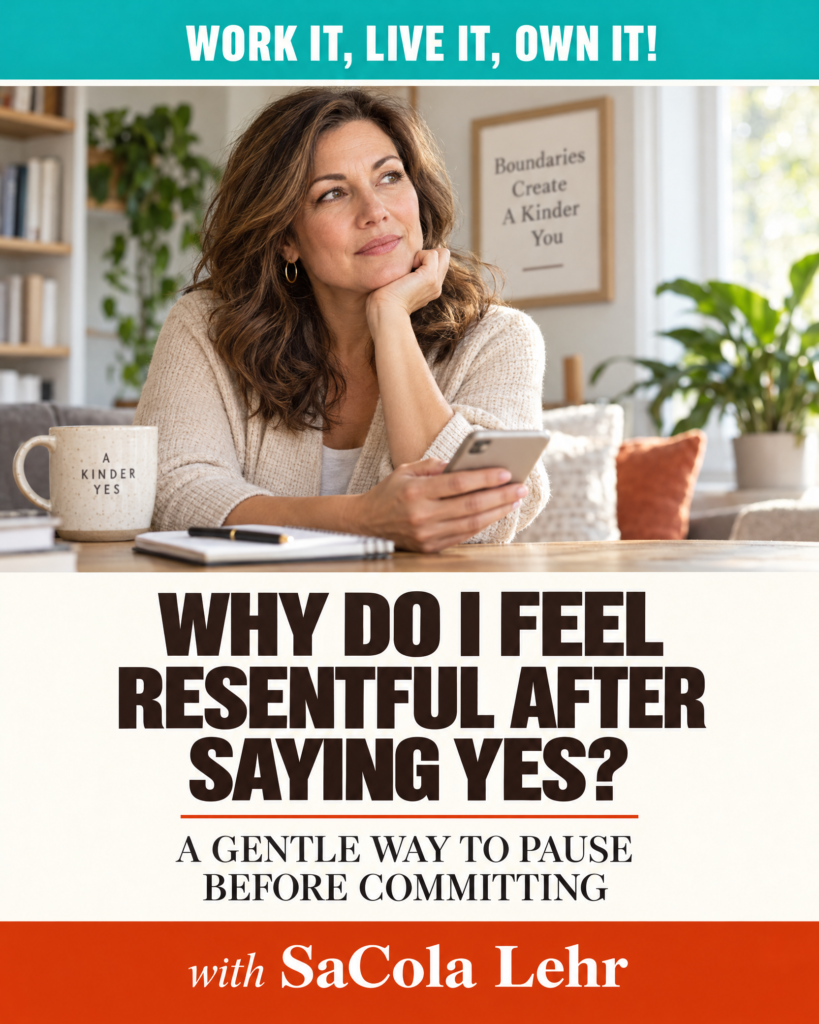
You said yes quickly. Maybe it felt good, or at least easy. Then later you feel irritated, heavy or even trapped. If you’re asking, “Why do I feel resentful after saying yes?”, the answer is often simple: you agreed before you checked what the request would cost you.That doesn’t make you unkind or ungrateful. It’s a very human moment.
Quick answer:
You may feel resentful when you say yes out of pressure, habit or urgency before considering your time, energy and tradeoffs. A short Capacity Pause before a non-emergency request gives you room for a more informed answer.
Resentful After Saying Yes
Why the feeling shows up later
When the ask comes in, it sounds doable. You’re capable, you care, and you don’t want to disappoint anyone.Then the real request appears: the messages, the planning, the follow-through, and the dinner, sleep or quiet hour it takes from you. The resentment comes late because the cost comes late.Being able to do something isn’t the same as having room to do it.
Why a fast yes feels safer
A quick yes keeps the peace. It makes you look dependable and spares you an awkward silence.Sometimes your options really are limited. A team may be understaffed, a care need may be urgent, or money, health or safety may leave little room. A pause doesn’t promise you can say no. It just helps you see what you’re taking on.
Try the Capacity Pause
Before one non-emergency request, say:
“I want to check my capacity before I commit. I’ll get back to you by [time].”
Then check three things:
Time: What does this really take, including the work around the work?
Energy: How much focus, patience or emotional presence will it need?
Tradeoff: What has to move, shrink, wait or be shared?
What an informed answer sounds like
“Let me look at what I have and get back to you tomorrow.”
“I can help with the first part, but not the follow-through.”
“If this is the priority, what should move?”
Your answer may still be yes. The goal isn’t more no’s. It’s a yes that includes you.
When it’s bigger than one request
If the pause keeps revealing overload, unshared care or unclear priorities, that’s a structural problem, not a personal flaw. Where it’s safe, ask for clearer roles, priorities or support. If it persists, reach out to a qualified resource.
Your next steps
In the next 24–48 hours, use the Capacity Pause once. Give yourself a specific reply time, then weigh your time, energy and tradeoffs.One pause won’t fix everything. It does remind you that your yes deserves to include your real life.
If this pause helped you see one responsibility more clearly, the PRONE to Power Starter Kit can help you name the load, clarify what matters, and choose one sustainable next step.
Keep listening:
Hear the full conversation on Work It, Live It, Own It: “Why You Feel Resentful After Saying Yes.” Then read When Everything Feels Urgent: How to Prioritize Without Carrying It All, or explore Harmony Hustle for Women.This article is for reflection and education. It isn’t individualized medical, mental-health, legal, employment, financial, caregiving or crisis advice. Seek qualified or urgent support when appropriate.
If this conversation resonated with you, Harmony Hustle for Women offers more practical guidance for creating work-life harmony without carrying everything alone. [Explore the book →]
Do you ever reach the end of a day feeling completely spent, then wonder why because your visible list does not look that impressive? You may be carrying an invisible load: the mental, physical, and emotional work of noticing, remembering, planning, coordinating, and caring that keeps life moving. It is real work, even when no one sees it.
However, work-life harmony is not about making every area of life perfectly equal. It is about creating a life that can hold what matters in this season without requiring you to disappear beneath everyone else’s needs.
What is the invisible load?
The invisible load is the work that happens before, around, and after a visible task: anticipating needs, remembering details, organizing plans, making decisions, following up, and often managing the emotional atmosphere around other people. Because it is easy to miss, it can make a full life look less demanding than it feels.
Sending the email is visible. Remembering it, anticipating questions, and following up are not. The same is true at home and in care-giving: the meal is visible; the planning behind it is easier to miss.
UN Women describes the mental load as the invisible work of anticipating needs, organizing tasks, and ensuring they are completed. Its examples extend beyond parenting to household management, support for aging relatives, community care, and workplace organizing. Caregiving is not only parenting, and the invisible load can exist in many kinds of lives.
Why you can feel exhausted when you are not “doing everything”
Exhaustion does not always come from the number of visible tasks you complete. It can also come from carrying responsibility in your mind—tracking details, switching between decisions, anticipating problems, and holding concern for other people while doing your paid work and daily life.
A capable woman can discount the work that depleted her: the preparation and emotional reading around two meetings, or the refill, family check-in, calendar conflict, and hard conversation she carried at home. It is an invitation to count what counts.
A 2023 systematic review in Sex Roles distinguishes mental labor, the cognitive work of planning unpaid household and care actions—from emotion work and physical tasks. The studies reviewed generally found women carrying more mental labor, while noting limits in whose experiences the research has represented.
The invisible load is not a personal-discipline problem
It can be tempting to hear “get organized” and think, Great. Another way I am supposed to do more. That is not the goal. A planner cannot create a fairer division of responsibilities, workplace clarity, care access, or the resources your situation may require. Structural pressure is real; not every problem can be solved by individual discipline.
Begin with visibility. An unnamed expectation is hard to renegotiate. O — Organize in PRONE to Power™ means creating supportive routines, calendars, systems, and structures—not becoming the better manager of everyone else’s needs.
Recognize the three kinds of work
Try looking at a responsibility through three lenses:
Kind of work
What it can sound like
Example
Mental
Remembering, planning, anticipating, tracking
“The appointment, form, and follow-up.”
Physical
Doing, transporting, preparing
“The drive and paperwork.”
Emotional
Reassuring, worrying, holding the tone
“Trying to keep the peace.”
The categories can overlap. The point is simply to give language to work that has been quietly taking energy.
One practical tool: the 48-hour Invisible-Load Inventory
For 48 hours, write down every responsibility you do or carry in your mind. Mark whether it is mental, physical, emotional, or a combination. Then decide where one repeat responsibility should live next: with you, shared, delegated, scheduled, simplified, delayed, or released.
Open the PRONE to Power™ Toolkitand use the Invisible-Load Inventory for two ordinary days. Ordinary days reveal recurring work.
For each item, capture three things:
1.What am I carrying? Keep it short: “follow up with client,” “check on aunt,” “plan meals,” “calm the team tension.”
2.What kind of work is this? Mark mental, physical, emotional, or more than one.
3.Where should it live next? Choose: me, shared, delegated, scheduled, simplified, delayed, or released.
Then choose one small Micro-Win. Ask, “What would make this less dependent on me remembering it alone?” Maybe it belongs on a shared calendar, with a colleague as the full owner of follow-up, or in a simpler routine. Shared ownership is not you creating a list and supervising it; it is another person owning a responsibility from noticing through follow-through.
A script for making the work visible
“I have noticed that I am carrying a lot of coordination work in the background. I am not looking for help with a list that I still have to manage. I want us to decide what each person can fully own, from noticing through follow-through. Can we take fifteen minutes to look at it together?”
“Before we begin, can we assign an owner and a next step for each part? I can lead this project, but I cannot also be the default person for reminders, logistics, and follow-up.”
A boundary is clear information about what you can sustainably offer. It is not evidence that you care less.
You do not have to carry it perfectly
Start the 48-hour Invisible-Load Inventory. Let it show you what is true about your current season. Then choose one recurring responsibility to share, schedule, simplify, delegate, delay, or release.
You can want meaningful achievement without abandoning yourself. Making invisible work visible is a first step toward a more supported, integrated way of living.
FAQs
What is the difference between the mental load and emotional labor?
Mental load is the cognitive work of noticing, remembering, planning, anticipating, and tracking tasks. Emotional labor is the work of managing feelings, relationships, comfort, and the emotional climate around people or situations. In daily life, the two often overlap with physical work.
Does the invisible load only apply to mothers?
No. Parenting can involve a significant invisible load, but so can leading at work, supporting an aging relative, managing a household, caring for a friend or community, coordinating a relationship, or becoming the person others expect to remember and respond.
How do I reduce my mental load without doing everything myself?
Begin by making the recurring work visible. Then move one responsibility out of your head and into a shared system, another person’s full ownership, a simpler routine, a later date, or a conscious release. The goal is not a perfect system; it is less hidden responsibility.
What if I cannot delegate the work right now?
You may not be able to delegate every task. Start with what is possible: name the load, lower a nonessential standard, schedule one repeat task, ask for one specific support, or seek appropriate workplace, care, or professional guidance.
By SaCola Lehr | Work-life harmony strategist, author, and host of Work it, Live it, Own it! podcast.
Guilt after setting boundaries is common, and it does not automatically mean you made the wrong choice. Sometimes the discomfort is a sign that a healthy decision conflicts with an old identity story, especially the belief that you must always be the dependable one.
You finally said no.
Maybe you declined the extra project, protected your weekend, turned off your laptop, or told someone you could not take one more thing on. The boundary itself may have been clear. Yet afterward, the guilt arrived.
You replay the conversation. You wonder whether you disappointed someone. You feel tempted to over explain, soften the boundary, or take the responsibility back.
In my conversation with Dr. Kim Foster, a former family physician, TEDx speaker, identity-based transformation expert, and author of Redesigning You: Change Your Inner Story, Transform Your Health, we explored why a healthy choice can still feel so uncomfortable.
Her perspective takes us beneath behavior and into the identity stories that shape our choices.
Dr. Kim Foster, MD
Why guilt after setting boundaries can feel so strong
Many women already understand the basics of setting a boundary. They know their health matters. They know their schedule has limits. They know that being available to everyone, all the time, eventually costs them something.
The challenge often comes after the boundary is set.
Dr. Foster explained that behavior tends to return to the identity we believe at our core:
“Your behavior is going to start to gravitate back to who you believe you are.”— Dr. Kim Foster
If your inner story says, I am the one everyone depends on, then protecting your time can feel like more than a practical decision. It can feel like you are becoming someone you are not allowed to be.
That is why boundary guilt can feel so strong. You are not simply changing a calendar entry. You may be stepping outside a role that once helped you belong, feel safe, or be valued.
If the guilt arrives as a morning-after urge to take back what you said, read why asking for help can feel so vulnerable. That reflection explores the vulnerability hangover that can follow an honest request or a healthy limit.
When “the dependable one” becomes too expensive
Being dependable is not a flaw. It can be a beautiful strength. It may be part of how you lead, care for your family, build trust, and move through difficult seasons.
But every strength needs room to breathe.
When “the dependable one” becomes your only identity, self-protection can begin to feel selfish. You may accept responsibilities that don’t fit. You may postpone rest until your body forces you to pause. You may believe you have to be available in order to be feel valuable.
Dr. Foster describes those identity labels as an instruction manual we may not realize has been written for us. It can quietly direct what we accept, how we respond, and the care we believe we are allowed to receive.
The answer is not to care less. The answer is to create an identity that makes room for you, too.
Let your past be a foundation, not a cage
Dr. Foster’s own career transition makes this message personal. After 20 years as a family physician, she felt called to help people earlier in the process, before stress and exhaustion became a crisis. Leaving clinical medicine was not an overnight decision. It required her to consider who she would be beyond a title that had shaped so much of her life.
Her reframe is one to carry into any new chapter:
“I had to let it be a foundation, not a cage.”— Dr. Kim Foster
Your past is not something you must erase in order to grow. Your education, experience, wisdom, and hard-won lessons can come with you. They can support what is next without deciding every choice you are allowed to make now.
A bridge identity is a practical next step
Changing an identity can feel overwhelming, especially when you have spent years proving the old one to yourself and everyone around you.
Dr. Foster offers a more compassionate next step: a bridge identity.
Instead of trying to jump from “I put everyone else first” to “I take perfect care of myself at all times,” choose language your mind can begin to believe:
I am someone who is learning how to prioritize myself.
Then build proof.
Keep one small promise to yourself today. Take the walk you said you would take. Leave work when you said you would leave. Take the lunch break. Make the appointment. Let that action become evidence that you can trust yourself.
Over time, those small choices support a new inner story.
A question to carry with you
When guilt comes after a boundary, pause before you respond to it. Ask yourself:
Who am I being in this moment? What identity is calling the shots here?
The first step is not to judge the answer. It is to notice it with honesty.
Listen to the conversation
Listen to “You’ve Set a Boundary. So Why Do You Still Feel Bad?” with Dr. Kim Foster for a compassionate conversation about identity, guilt, self-protection, and work-life harmony.
Guilt after setting boundaries can happen when a healthy choice conflicts with an identity story, such as believing you must always be available, helpful, or dependable. The discomfort is worth noticing, but it does not automatically mean that the boundary was wrong.
Does guilt mean my boundary is wrong?
No. Guilt can be a signal to reflect, but it is not proof that your boundary is unkind or unreasonable. Consider whether your choice protects your time, health, values, or commitments. If it does, the discomfort may be part of practicing a new way of relating to yourself.
What is a bridge identity?
A bridge identity is a believable next-step statement that helps you practice a new pattern without demanding a total reinvention. For example, “I am someone who is learning how to prioritize myself” may feel more possible than trying to become perfectly self-protective overnight.
How can I set boundaries without guilt?
The aim is not necessarily to eliminate guilt immediately. Start by noticing the thought behind it, choose one bridge identity, and keep a small promise to yourself. Each aligned action becomes evidence that you can care for others while also including yourself in the care.
About Dr. Kim Foster
Dr. Kim Foster is a former family physician, TEDx speaker, identity-based transformation expert, and author of Redesigning You: Change Your Inner Story, Transform Your Health. Visit Dr. Kim Foster’s website for her work and current resources. You can also find her educational content on YouTube.
If this message gave you language for something you have been carrying, share this article with the woman in your life who is known as “the dependable one.” She may not need permission to care less. She may need permission to include herself in the care.
Have you ever asked for help, set a boundary, or admitted that you could not do one more thing, and then immediately wished you could take it back?
Perhaps you told your partner, “I need you to take over tonight.” Maybe you told a colleague, “That deadline is not realistic.” You might have finally shared with a friend that you have been struggling, only to wake up the next morning replaying every word.
Did I say too much? Did I sound incapable? Should I send a follow-up message and explain myself?
That uncomfortable morning-after feeling has a name: the vulnerability hangover.
What is a vulnerability hangover?
The term is often associated with researcher Brené Brown. It describes the wave of exposure, anxiety, and second-guessing that can follow an emotionally honest moment. You take a risk by letting someone see your needs or limits, and then your mind begins looking for a way back to the familiar.
The important part is this: discomfort does not automatically mean you made the wrong decision. Sometimes it means you did something new.
For women who have spent years being dependable, capable, and self-sufficient, asking for support can feel more threatening than continuing to carry too much. Self-reliance may have protected you in the past when it comes to success, caring for others, and life. However, a strategy that helped you survive in the past can eventually make connection feel unsafe.
Listen to the episode
Why the strong one wants to retreat
When you are accustomed to being the person with the answers, vulnerability can feel like a new identity. You are no longer performing at a competent level. You are allowing other people to see the part of you that is in need, or unsure.
That can activate a familiar internal script:
“If I can handle it myself, I cannot be disappointed.”
The script sounds protective, but it can leave you isolated. You may have plenty of people around you and still lack relationships where your needs have room to exist.
Brené Brown explains in her work on vulnerability, vulnerability is not the opposite of courage; it is one of the ways courage becomes visible. Martha Beck describes the discomfort of vulnerability as connected to the possibility of being hurt. The uneasiness is real, but it is not proof that honesty was a mistake.
A real-life example
Imagine telling a high-stakes client that you cannot meet an unrealistic deadline. You communicate clearly and professionally. You make a reasonable request. Then, the next morning, anxiety arrives before your coffee does. You start drafting an apology. You might even consider offering to work through the weekend. The impulse is not necessarily evidence that your boundary was wrong. It may be the old survival strategy asking to take the wheel again.
Before you undo the boundary, pause and ask: Am I responding to new information, or am I trying to escape the discomfort of being seen?
That question creates room for discernment. It helps you separate a genuine repair from an anxiety-driven retreat.
How to move through a vulnerability hangover
You do not have to force yourself to feel confident immediately. Instead, try this simple process.
1. Expect some discomfort
If you know that asking for help may bring up discomfort afterward, the feeling will be less surprising. You can tell yourself, “This may feel uncomfortable tomorrow, but that does not mean I need to undo it.”
2. Name what is happening
Use plain language: “I am having a vulnerability hangover.” Naming the experience creates a little distance between the feeling and the story your mind is creating around it.
3. Delay the retreat
Do not send the “never mind” text while you are activated. Give yourself time before apologizing, over-explaining, volunteering to take everything back, or changing a reasonable boundary.
4. Check the facts
Ask what actually happened. Did the person reject you, or are you imagining that they will? Did the conversation create a problem, or did it simply feel unfamiliar? You can address real consequences without assuming that your needs are the problem.
5. Let support be reciprocal
Receiving support may feel uncomfortable when you are used to providing it. Still, relationships become more honest when care can move in both directions. You are not taking up too much space by allowing someone to show up for you.
A small practice for this week
The next time you ask for help or set a boundary, write down what you said and why you said it. The following day, when the vulnerability hangover appears, read your note before you revise your decision.
Remind yourself
“I can feel uncomfortable without abandoning myself.”
You don’t have to over explain. You can be capable and still need support.
Your vulnerability is not a leadership flaw or a relationship failure. It may simply be evidence that you are making room for a more honest, integrated life.
Listen to the episode
Listen to this conversation on the Work it, Live it, Own it! podcast, and remember: you do not have to return to survival mode just because courage feels unfamiliar.
This blog offers reflection and education, not medical or mental-health treatment. If vulnerability, anxiety, or relationship concerns feel overwhelming or unsafe, consider seeking support from a qualified professional.
There is a particular kind of loneliness that does not look like loneliness from the outside. Sometimes, feeling alone does not mean you lack people. It means you are surrounded by people, yet still do not feel truly supported.
You may be surrounded by colleagues, family members, friends, clients, or community members. Your phone is always ringing. Your inbox is full. People trust your judgment, ask for your advice, and look to you when something needs to be solved. You are dependable. You are capable. You are the person others count on.
And yet, somewhere underneath all of that usefulness, you may be wondering: Who do I get to be when I am not solving, organizing, leading, or holding everything together?
That is the conversation behind this month’s episode of Work it, Live it, Own it!: “Everyone Relies on You, But Who Do You Rely On?”
The episode explores the loneliness that can accompany leadership, caregiving, partnership, friendship, family responsibility, and the everyday work of being the person others count on. It is not a judgment against the people you love or work with. It is an honest look at what happens when your role becomes so closely associated with being capable that people forget you need care, too.
When being dependable becomes an identity
Being dependable can be a wonderful superpower. It can help you build trust, lead through uncertainty, and create stability for the people around you. The challenge begins when dependability becomes the only version of you that others get to see.
You become the person who remembers the details, anticipates the needs, absorbs the tension, and steps in before anyone has to ask. At work, you may be the one who can be trusted with the difficult client or complicated project. At home, you may coordinate the appointments, meals, schedules, decisions, and emotional temperature of the household. In your relationships, you may listen carefully to everyone else while keeping your own concerns neatly tucked away.
Over time, this pattern can create an uncomfortable paradox: the more useful you become, the less visible your own needs may be.
Research on leadership offers one window into a much broader human experience. One study reported that 61 percent of chief executives experienced loneliness in their role, while other research has examined how leadership can affect loneliness differently across genders . These findings do not mean that every leader is lonely, and they do not define the experience of every caregiver, partner, friend, or family member. They do remind us, however, that responsibility and connection are not automatically the same thing. The same pattern can appear anywhere one person becomes the dependable center of everyone else’s life.
You can have influence and still feel unsupported. You can have a full calendar and still lack a person you can call when you are the one who does not know what to do next.
The difference between a network and a support system
Many women have extensive networks. They know people. They collaborate, mentor, advise, encourage, and connect others. They may have hundreds of contacts and still struggle to identify one person who knows when they are having a difficult week.
A network often knows what you do. A support system knows how you are doing.
That distinction matters. A network may celebrate your accomplishments, but a support system also makes room for your uncertainty. A network may ask for your insight, but a support system asks what you need. A network may admire your strength, but a support system does not require you to perform strength every time you walk into the room.
This is not about rejecting leadership, becoming less capable, or stepping away from the people you love. It is about allowing your relationships to become more reciprocal. It is about creating room for care to move in both directions.
Why asking for support can feel so uncomfortable
If you are accustomed to handling things yourself, asking for support may feel more vulnerable than it sounds. You may worry that you are inconveniencing someone, appearing unprepared, or changing the role people have come to expect from you.
Sometimes the concern is not, “Will they help me?” It is, “What will they think of me now that they know I need help?”
That question can keep you isolated even when support is available. You may minimize what you are carrying because someone else appears to have more urgent needs. You may wait until you are depleted before speaking. You may offer a long explanation because a simple request feels too exposed.
But support does not have to begin with a dramatic disclosure. It can begin with something honest and manageable:
“I have been carrying more than I have said. I do not need you to solve it, but I would really appreciate a few minutes to talk.”
Or:
“I am usually the person who has a plan, but I do not have one today. Can you sit with me while I think this through?”
The goal is not to hand your entire life to someone else. The goal is to stop pretending that you have no life to carry.
My moment of realizing I had built the wrong kind of community
I share a moment from the episode that continues to stay with me. I was standing in a crowded networking room, surrounded by colleagues and acquaintances. People approached me for advice, ideas, and solutions. They told me how much they admired my drive. I smiled, listened, and responded in the way I had trained myself to respond: by being helpful.
From the outside, I was connected. Inside, I felt completely alone.
That moment helped me see that I had built a network of people who needed me, but I had not intentionally built a community that knew how to support me. I had become very good at being available and very unfamiliar with being held.
That realization was not comfortable, but it was clarifying. It showed me that connection requires more than proximity. It requires honesty, reciprocity, and the willingness to let someone see more than the polished version of our lives.
A gentle practice: the support-circle audit
This week, consider taking a quiet look at your inner circle. You do not need a complicated system or another project to manage. Just ask yourself three questions:
Question
What it helps you notice
Who knows when I am struggling?
Whether your relationships include emotional visibility.
Who can support me without needing me to perform or explain everything perfectly?
Where safety and reciprocity already exist.
What is one honest request I could make this week?
The smallest next step toward receiving support.
If one person comes to mind, begin there. Share one real thing—not necessarily the hardest thing. You might say, “I have been feeling stretched thin,” or “I realized I have been trying to manage this alone.” Then allow the conversation to unfold without immediately turning it back toward the other person.
Receiving support may feel unfamiliar at first. That does not mean it is wrong. It may simply mean you are practicing a different form of strength.
Empowerment is not isolation
In the PRONE to Power framework, this conversation connects with Empowerment. Empowerment is not the endless extension of your capacity. It is not proving that you can carry more than everyone else. It is the freedom to make choices that honor your humanity, including the choice to ask for help before you reach a breaking point.
You do not have to earn support by becoming indispensable. You do not have to wait until you are in crisis to deserve care. You do not have to make yourself smaller or less capable in order to let someone else contribute.
Your goals and dreams matter. So do your relationships, your health, and your well-being. Work-life integration becomes more sustainable when responsibility is shared and connection is genuine—not when one person quietly becomes the foundation for everyone else.
So, if everyone relies on you, take a moment to ask the question that may change the way you move through this season:
Who do you rely on?
You are allowed to be supported. You are allowed to be known beyond what you accomplish. And you are allowed to move from burnout to brilliance with other people beside you.
For years, I bought into a narrative that so many of us are sold: the “boss babe” hustle. I believed that success required a relentless rise-and-grind mentality. I worked my 9-to-5, ran my business late into the night, and answered emails with a knot of anxiety tight in my chest. I thought I was building an empire, but in reality, I was building a cage.
It wasn’t until I was knocked flat by a four-month bout of walking pneumonia that I finally understood what my body had been trying to tell me. The hustle mentality is highly overrated.
I recently had the opportunity to sit down with Chase Friedman on the In Pursuit of Purpose podcast. We had an incredibly honest conversation about the “messy middle” of entrepreneurship, the origins of our drive, and how we can finally stop treating our fluctuating demands as personal failures.
The Origins of the Hustle
During the episode, Chase asked me a profound question: Where did the need to be this “boss babe” stem from?
To answer that, I had to look back at my childhood. My early years shifted rapidly from stability to a single-parent home, to low-income housing, and eventually to homelessness. I remember the hollow feeling of opening a refrigerator and finding absolutely nothing inside.
As a teenager, I made a vow to myself. I decided I would hustle tooth and nail to ensure my refrigerator was always full. I would never go without. That survival instinct pushed me to start working at sixteen, to grind through college, and to constantly bring my A-game.
But survival mode is not a sustainable business strategy. When we operate out of scarcity, we take on projects that drain us and clients that do not align with our vision. We carry the burdens of our families, our colleagues, and society on our backs, secretly wondering, Who is going to show up for me?
Redefining Success: Wellbeing is Wealth
Society rewards output. It rewards production. We are taught that if we are not constantly producing results, we are failing. That is a lie.
You can have a successful life and career without the crushing weight of chronic stress. You do not have to multitask to the point of dropping the ball on the things that truly matter. Real life is full of fluctuating demands there will be seasons of intense work and seasons that require deep rest. Acknowledging this rhythm is not a failure; it is the essence of true work-life harmony.
As I told Chase on the podcast, my purpose in this season of life has shifted. Today, my wellbeing is my wealth. If I do not take care of my physical, emotional, and spiritual health, I surely cannot show up for my family, my team, or my clients.
The PRONE to Power Framework
This realization is what birthed my book, Harmony Hustle for Women. It is a guide written from the messy middle, designed to help you take burnout and turn it into brilliance. At its core is the PRONE framework, a compassionate approach to finding synergy in your daily life:
•P — Prioritize: Not everything that is urgent is important. Learn to identify what truly moves the needle in your current season.
•R — Rejuvenate: Your body will tell you when enough is enough. Listen to it. Step away, take a breath, and refill your cup.
•O — Organize: Get your goals out of your head and onto paper. You do not have to accomplish everything at once.
•N — Navigate Boundaries: Learn the art of delegation. Allow your team to shine in their own brilliance so you can shine in yours.
•E — Empowered: Step into your leadership with humanity, empathy, and grace for others, and most importantly, for yourself.
Filling Your Cup
Author Iyanla Vanzant often talks about the concept of the cup. What is in the cup is for you; what is overflowing from the cup is for everyone else. For too long, women have been pouring from an empty cup, scraping the bottom just to give a little more to those around us.
It is time to change the narrative. It is time to embrace a rhythm that honors our humanity.
If you are tired of chasing someone else’s version of success, I invite you to listen to my full conversation with Chase Friedman on In Pursuit of Purpose. And if you are ready to master the art of thriving in both life and career, pick up a copy of Harmony Hustle for Women at https://sacolalehr.com/harmony-hustle-for-women/
Let’s throw out the boss babe manual and start building lives of true purpose, prosperity, and peace of mind.
SaCola Lehr is the author of Harmony Hustle for Women: Master the Art of Thriving in Life and Career and host of the Work It, Live It, Own It podcast.
Here is a truth that might make you uncomfortable: rest is not a reward for exhaustion. It is a requirement for brilliance. If you are treating rest like another metric to conquer, or a luxury you have to earn by completely emptying your tank first, you are not resting. You are just recovering from burnout. To move from burnout to brilliance, you must learn how to rest without feeling guilty.
For women who are used to driving results, managing households, and leading teams, the concept of doing nothing feels entirely foreign. We have been conditioned to believe that every minute must be productive. So, when we finally do take a break, we turn rest into a project. We read self-improvement books on the beach. We listen to industry podcasts while we run. We use our weekends to meal prep, organize the garage, and catch up on emails. We are “resting” our bodies, but our minds are still running a marathon.
The problem is that this kind of optimized downtime does not restore us; it just changes the scenery of our exhaustion.
The Trap of Optimized Downtime: Why You Can’t Rest Without Feeling Guilty
Why do we do this? Because stillness feels dangerous when your entire identity is built on being capable and productive. If you stop moving, you might have to sit with the exhaustion you have been outrunning. Society tells us that our value is tied to our output. So, we feel guilty when we are not producing. We believe that if we are not constantly moving forward, we are falling behind. This mindset turns rest into a source of anxiety rather than a source of renewal, making it nearly impossible to rest without feeling guilty.
I know this cycle intimately. I remember taking my first real beach vacation in years. I was supposed to be unplugging. But instead of listening to the ocean, I spent the first three days sitting under an umbrella with a notebook, furiously outlining my goals for the next quarter. I was so terrified of losing momentum that I could not even let myself enjoy the sand. I was physically on vacation, but mentally, I was still in the office.
It was not until I realized that my inability to rest was actually sabotaging my brilliance that I knew something had to change.
Navigating Your Boundaries Around Rest
This brings us to the “N” in the PRONE to Power framework: Navigating Boundaries.
Navigating boundaries is not just about saying no to other people; it is about saying no to the voice in your own head that tells you to keep working when you are supposed to be resting. It is about creating a boundary around your downtime and fiercely protecting it from the infiltration of productivity.
If you are reading this and realizing you have not actually rested in years, that you have just been recovering from exhaustion so you can go back to producing, I want you to know: that realization is heavy. You are not broken for not knowing how to stop. You were trained to be this way by a world that profits from your endless output.
But you are allowed to stop producing. You are allowed to have time that belongs to absolutely no one, not even your own self-improvement goals.
Your Action Step: Learning How to Rest Without Feeling Guilty
This week, I want you to give yourself fifteen minutes of completely unproductive time. No podcasts. No planning. No organizing. Just sit. Stare out a window. Drink your coffee without scrolling. When the urge to “do something useful” hits you, just notice it, and stay seated. Just fifteen minutes. This small window is your first step in practicing how to rest without feeling guilty.
Remember, you can accomplish your goals and dreams without forsaking your family, your health, and your well-being. True brilliance requires genuine rest. It is time to move from burnout to brilliance.
Here is a truth that no one tells you about success: being the “strong one” is not a personality trait. It is a survival strategy. And it is costing you more than you know.
Today, we are talking about a skill that so many of you have mastered, yet no one ever talks about it. It is the ability to function while completely emotionally depleted. You know how to show up professionally, solve everyone else’s problems, support your team, and perform leadership flawlessly, all while quietly carrying stress, grief, burnout, or loneliness. From the outside, it looks like incredible strength. But from the inside, it feels like survival. If you have ever thought to yourself, “I know how to succeed, but I am not sure I know how to rest,” this message is for you.
Press play to listen to the entire episode
The Reality of the Mask
As women, especially those of us navigating the middle chapters of our lives and careers, we are often praised for our capacity to handle everything. We become the go-to person at work, the anchor for our families, and the sounding board for our friends. The problem is that this constant output creates a mask. We become so adept at managing crises and driving results that we lose touch with our own emotional depletion. We look strong on the outside, but inside, we are running on fumes. We have bought into the narrative that asking for help or taking a pause is a sign of weakness, or worse, a failure.
Why does this happen? It’s because society and workplace cultures heavily reward output and resilience without ever acknowledging the emotional toll it takes to produce those results. The “Rise and Grind” mentality has conditioned us to believe that our worth is tied to our productivity. We are taught that success requires sacrificing our well-being, which is a lie. When you are the strong one, people assume you do not need support. And because you are so used to handling it all, you stop asking for it. You wire your nervous system for constant action, making the very idea of resting feel uncomfortable or even guilt-inducing.
The Driveway Moment
I know exactly how this feels because I lived it. I remember sitting in my car in the driveway after a twelve-hour day, gripping the steering wheel, completely exhausted, but unable to go inside because I knew the moment I walked through the door, someone would need me to solve another problem. I was the strong one for everyone else, but I was completely empty. That moment in the driveway was my breaking point. It was the moment I realized that my strength had become my cage.
This is where the P in the PRONE to Power framework comes in: Prioritize. Prioritizing is not just about managing your calendar; it is about managing your energy. It is about recognizing that you cannot pour from an empty cup, and that your well-being is a non-negotiable priority, not an afterthought.
Dismantling the Mask
So, how do we start dismantling the mask of the “strong one”? We start right here.
If you are carrying the weight of everyone else’s world right now, I want you to know that that weight is real. You are not imagining it, and you are not weak for feeling exhausted by it. You have been running on survival mode for so long that you forgot what it feels like to be supported.
You are allowed to put some of it down. Not all of it. Just some of it. Today. You do not have to fix everything for everyone before you are allowed to rest.
This week, I want you to do one thing: find one ten-minute window where you are completely unreachable. Do not solve a problem. Do not answer a text. Do not fold a single piece of laundry. Just sit in your car, or your bedroom, or your office, and let yourself be off the clock. That’s it, just ten minutes of not being the strong one.
Remember, you can accomplish your goals and dreams without forsaking your family, your health, and your well-being. It is time to move from burnout to brilliance.
We have all been there. You are at a family dinner, a networking event, or standing in the school pickup line, and someone asks the question.
“When are you having kids?”
“Are you really going to stay at that job forever?”
“When are you going to settle down?”
Society’s timeline does not just live in our heads. It lives in the mouths of well-meaning relatives, curious coworkers, and friends who think they are just making conversation.
Here is the truth about those questions: they are not innocent curiosity. They are a timeline wearing a smile. And they are exhausting. Keep reading to learn How to Respond to Personal Questions About Your Life (Without Over-Explaining).
The Difference Between Love and Entitlement
When someone asks you a deeply personal question about your life choices, it is easy to feel like you owe them an answer. Especially if it is someone you love. You start over-explaining, start justifying your choices, or try to make them understand why you are doing things differently.
But here is the paradigm shift you need to make today: Caring about someone and being entitled to their life plan are two entirely different things.
You do not owe anyone a justification for the life you are building. You do not need to convince your aunt that your career path is valid, or explain to a friend why your family looks the way it does. Your path is yours. Your timing is yours.
The Calm, Close, Redirect Method
In this week’s bonus episode of Work it, Live it, Own it!, we are taking the Empowerment element of the PRONE to Power framework and applying it directly to these conversations.
Empowerment is not about starting a fight at the Thanksgiving table. It is about becoming so settled in your own choices that timeline questions simply have nowhere to land.
To help you do that, I am sharing the Calm, Close, Redirect Method—three exact scripts you can use to shut down personal questions with warmth, confidence, and zero apologies. Whether you are dealing with a well-meaning relative, a persistent pusher, or a subtle judger, these scripts will help you protect your peace without burning bridges.
Stop Over-Explaining
The next time someone asks you a question that makes you feel like you are falling behind on society’s timeline, remember this: you do not have to pick up the rope. You can simply smile, redirect, and keep living the life that actually fits you.
Ready to learn the exact scripts? Listen to the full bonus episode now.