relationships

  • Why Asking for Help Can Feel So Vulnerable

    Have you ever asked for help, set a boundary, or admitted that you could not do one more thing, and then immediately wished you could take it back?

    Perhaps you told your partner, “I need you to take over tonight.” Maybe you told a colleague, “That deadline is not realistic.” You might have finally shared with a friend that you have been struggling, only to wake up the next morning replaying every word.

    Did I say too much? Did I sound incapable? Should I send a follow-up message and explain myself?

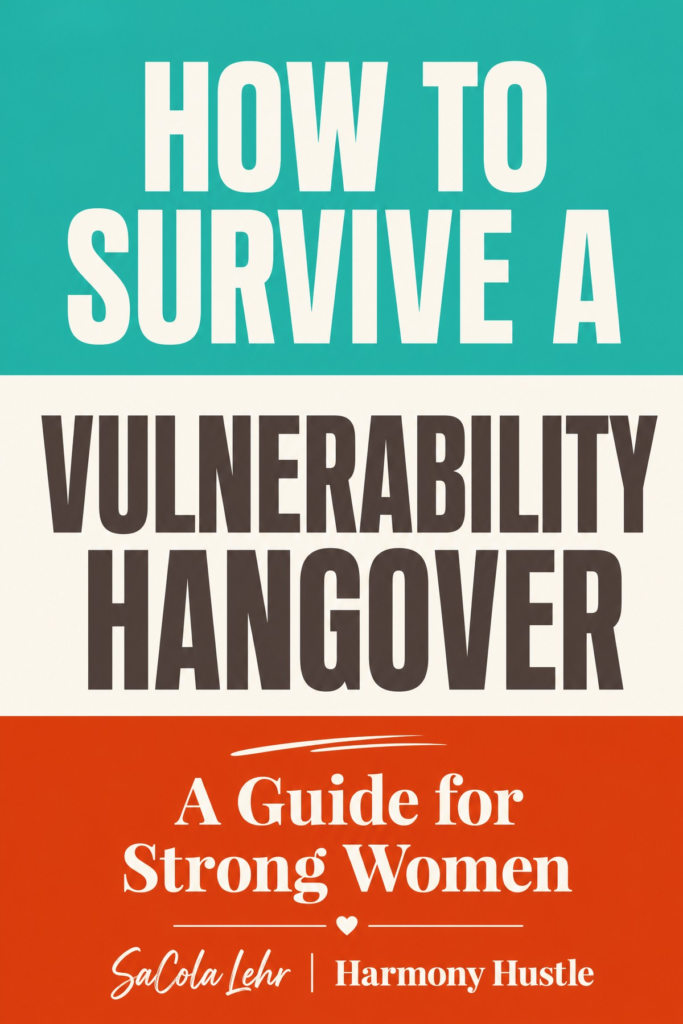
    That uncomfortable morning-after feeling has a name: the vulnerability hangover.

    What is a vulnerability hangover?

    The term is often associated with researcher Brené Brown. It describes the wave of exposure, anxiety, and second-guessing that can follow an emotionally honest moment. You take a risk by letting someone see your needs or limits, and then your mind begins looking for a way back to the familiar.

    The important part is this: discomfort does not automatically mean you made the wrong decision. Sometimes it means you did something new.

    For women who have spent years being dependable, capable, and self-sufficient, asking for support can feel more threatening than continuing to carry too much. Self-reliance may have protected you in the past when it comes to success, caring for others, and life. However, a strategy that helped you survive in the past can eventually make connection feel unsafe.

    Listen to the episode

    Why the strong one wants to retreat

    When you are accustomed to being the person with the answers, vulnerability can feel like a new identity. You are no longer performing at a competent level. You are allowing other people to see the part of you that is in need, or unsure.

    That can activate a familiar internal script:

    “If I can handle it myself, I cannot be disappointed.”

    The script sounds protective, but it can leave you isolated. You may have plenty of people around you and still lack relationships where your needs have room to exist.

    Brené Brown explains in her work on vulnerability, vulnerability is not the opposite of courage; it is one of the ways courage becomes visible. Martha Beck describes the discomfort of vulnerability as connected to the possibility of being hurt. The uneasiness is real, but it is not proof that honesty was a mistake.

    A real-life example

    Imagine telling a high-stakes client that you cannot meet an unrealistic deadline. You communicate clearly and professionally. You make a reasonable request. Then, the next morning, anxiety arrives before your coffee does. You start drafting an apology. You might even consider offering to work through the weekend. The impulse is not necessarily evidence that your boundary was wrong. It may be the old survival strategy asking to take the wheel again.

    Before you undo the boundary, pause and ask: Am I responding to new information, or am I trying to escape the discomfort of being seen?

    That question creates room for discernment. It helps you separate a genuine repair from an anxiety-driven retreat.

    How to move through a vulnerability hangover

    You do not have to force yourself to feel confident immediately. Instead, try this simple process.

    1. Expect some discomfort

    If you know that asking for help may bring up discomfort afterward, the feeling will be less surprising. You can tell yourself, “This may feel uncomfortable tomorrow, but that does not mean I need to undo it.”

    2. Name what is happening

    Use plain language: “I am having a vulnerability hangover.” Naming the experience creates a little distance between the feeling and the story your mind is creating around it.

    3. Delay the retreat

    Do not send the “never mind” text while you are activated. Give yourself time before apologizing, over-explaining, volunteering to take everything back, or changing a reasonable boundary.

    4. Check the facts

    Ask what actually happened. Did the person reject you, or are you imagining that they will? Did the conversation create a problem, or did it simply feel unfamiliar? You can address real consequences without assuming that your needs are the problem.

    5. Let support be reciprocal

    Receiving support may feel uncomfortable when you are used to providing it. Still, relationships become more honest when care can move in both directions. You are not taking up too much space by allowing someone to show up for you.

    A small practice for this week

    The next time you ask for help or set a boundary, write down what you said and why you said it. The following day, when the vulnerability hangover appears, read your note before you revise your decision.

    Remind yourself

    “I can feel uncomfortable without abandoning myself.”

    You don’t have to over explain. You can be capable and still need support.

    Your vulnerability is not a leadership flaw or a relationship failure. It may simply be evidence that you are making room for a more honest, integrated life.

    Listen to the episode

    Listen to this conversation on the Work it, Live it, Own it! podcast, and remember: you do not have to return to survival mode just because courage feels unfamiliar.

    References

    [1] How to Nurse a Vulnerability Hangover, According to Brené Brown — Refinery29

    [2] Ready for a Vulnerability Hangover? Five Ideas from Brené Brown — Roman Krznaric

    [3] Vulnerability Hangovers — Martha Beck

    [4] Vulnerability Hangovers: Key Insights — Kristen Jacobsen, LCPC

    Note

    This blog offers reflection and education, not medical or mental-health treatment. If vulnerability, anxiety, or relationship concerns feel overwhelming or unsafe, consider seeking support from a qualified professional.

  • Feeling Unsupported? Everyone Relies on You, But Who Do You Rely On?

    The quiet loneliness of being the strong one

    There is a particular kind of loneliness that does not look like loneliness from the outside. Sometimes, feeling alone does not mean you lack people. It means you are surrounded by people, yet still do not feel truly supported.

    You may be surrounded by colleagues, family members, friends, clients, or community members. Your phone is always ringing. Your inbox is full. People trust your judgment, ask for your advice, and look to you when something needs to be solved. You are dependable. You are capable. You are the person others count on.

    And yet, somewhere underneath all of that usefulness, you may be wondering: Who do I get to be when I am not solving, organizing, leading, or holding everything together?

    That is the conversation behind this month’s episode of Work it, Live it, Own it!: “Everyone Relies on You, But Who Do You Rely On?”

    The episode explores the loneliness that can accompany leadership, caregiving, partnership, friendship, family responsibility, and the everyday work of being the person others count on. It is not a judgment against the people you love or work with. It is an honest look at what happens when your role becomes so closely associated with being capable that people forget you need care, too.

    When being dependable becomes an identity

    Being dependable can be a wonderful superpower. It can help you build trust, lead through uncertainty, and create stability for the people around you. The challenge begins when dependability becomes the only version of you that others get to see.

    You become the person who remembers the details, anticipates the needs, absorbs the tension, and steps in before anyone has to ask. At work, you may be the one who can be trusted with the difficult client or complicated project. At home, you may coordinate the appointments, meals, schedules, decisions, and emotional temperature of the household. In your relationships, you may listen carefully to everyone else while keeping your own concerns neatly tucked away.

    Over time, this pattern can create an uncomfortable paradox: the more useful you become, the less visible your own needs may be.

    Research on leadership offers one window into a much broader human experience. One study reported that 61 percent of chief executives experienced loneliness in their role, while other research has examined how leadership can affect loneliness differently across genders . These findings do not mean that every leader is lonely, and they do not define the experience of every caregiver, partner, friend, or family member. They do remind us, however, that responsibility and connection are not automatically the same thing. The same pattern can appear anywhere one person becomes the dependable center of everyone else’s life.

    You can have influence and still feel unsupported. You can have a full calendar and still lack a person you can call when you are the one who does not know what to do next.

    The difference between a network and a support system

    Many women have extensive networks. They know people. They collaborate, mentor, advise, encourage, and connect others. They may have hundreds of contacts and still struggle to identify one person who knows when they are having a difficult week.

    A network often knows what you do. A support system knows how you are doing.

    That distinction matters. A network may celebrate your accomplishments, but a support system also makes room for your uncertainty. A network may ask for your insight, but a support system asks what you need. A network may admire your strength, but a support system does not require you to perform strength every time you walk into the room.

    This is not about rejecting leadership, becoming less capable, or stepping away from the people you love. It is about allowing your relationships to become more reciprocal. It is about creating room for care to move in both directions.

    Why asking for support can feel so uncomfortable

    If you are accustomed to handling things yourself, asking for support may feel more vulnerable than it sounds. You may worry that you are inconveniencing someone, appearing unprepared, or changing the role people have come to expect from you.

    Sometimes the concern is not, “Will they help me?” It is, “What will they think of me now that they know I need help?”

    That question can keep you isolated even when support is available. You may minimize what you are carrying because someone else appears to have more urgent needs. You may wait until you are depleted before speaking. You may offer a long explanation because a simple request feels too exposed.

    But support does not have to begin with a dramatic disclosure. It can begin with something honest and manageable:

    “I have been carrying more than I have said. I do not need you to solve it, but I would really appreciate a few minutes to talk.”

    Or:

    “I am usually the person who has a plan, but I do not have one today. Can you sit with me while I think this through?”

    The goal is not to hand your entire life to someone else. The goal is to stop pretending that you have no life to carry.

    My moment of realizing I had built the wrong kind of community

    I share a moment from the episode that continues to stay with me. I was standing in a crowded networking room, surrounded by colleagues and acquaintances. People approached me for advice, ideas, and solutions. They told me how much they admired my drive. I smiled, listened, and responded in the way I had trained myself to respond: by being helpful.

    From the outside, I was connected. Inside, I felt completely alone.

    That moment helped me see that I had built a network of people who needed me, but I had not intentionally built a community that knew how to support me. I had become very good at being available and very unfamiliar with being held.

    That realization was not comfortable, but it was clarifying. It showed me that connection requires more than proximity. It requires honesty, reciprocity, and the willingness to let someone see more than the polished version of our lives.

    A gentle practice: the support-circle audit

    This week, consider taking a quiet look at your inner circle. You do not need a complicated system or another project to manage. Just ask yourself three questions:

    QuestionWhat it helps you notice
    Who knows when I am struggling?Whether your relationships include emotional visibility.
    Who can support me without needing me to perform or explain everything perfectly?Where safety and reciprocity already exist.
    What is one honest request I could make this week?The smallest next step toward receiving support.

    If one person comes to mind, begin there. Share one real thing—not necessarily the hardest thing. You might say, “I have been feeling stretched thin,” or “I realized I have been trying to manage this alone.” Then allow the conversation to unfold without immediately turning it back toward the other person.

    Receiving support may feel unfamiliar at first. That does not mean it is wrong. It may simply mean you are practicing a different form of strength.

    Empowerment is not isolation

    In the PRONE to Power framework, this conversation connects with Empowerment. Empowerment is not the endless extension of your capacity. It is not proving that you can carry more than everyone else. It is the freedom to make choices that honor your humanity, including the choice to ask for help before you reach a breaking point.

    You do not have to earn support by becoming indispensable. You do not have to wait until you are in crisis to deserve care. You do not have to make yourself smaller or less capable in order to let someone else contribute.

    Your goals and dreams matter. So do your relationships, your health, and your well-being. Work-life integration becomes more sustainable when responsibility is shared and connection is genuine—not when one person quietly becomes the foundation for everyone else.

    So, if everyone relies on you, take a moment to ask the question that may change the way you move through this season:

    Who do you rely on?

    You are allowed to be supported. You are allowed to be known beyond what you accomplish. And you are allowed to move from burnout to brilliance with other people beside you.

    Listen to “Everyone Relies on You, But Who Do You Rely On?” on Work it, Live it, Own it! with SaCola Lehr.

    References

    [1] Loneliness in Leadership: Why Leaders Often Feel Isolated — CMA

    [2] Gender-Contingent Effects of Leadership on Loneliness — APA PsycNet

    This article is for educational purposes and is not a substitute for mental-health or professional advice.

    SaCola Lehr

    Work it, Live it, Own it!
    From Burnout to Brilliance
    Work-life harmony strategist