burnout

  • Why You’re So Tired: The Mental Load You Carry Without Realizing It

    Do you ever reach the end of a day feeling completely spent, then wonder why because your visible list does not look that impressive? You may be carrying an invisible load: the mental, physical, and emotional work of noticing, remembering, planning, coordinating, and caring that keeps life moving. It is real work, even when no one sees it.

    However, work-life harmony is not about making every area of life perfectly equal. It is about creating a life that can hold what matters in this season without requiring you to disappear beneath everyone else’s needs.

    What is the invisible load?

    The invisible load is the work that happens before, around, and after a visible task: anticipating needs, remembering details, organizing plans, making decisions, following up, and often managing the emotional atmosphere around other people. Because it is easy to miss, it can make a full life look less demanding than it feels.
    Sending the email is visible. Remembering it, anticipating questions, and following up are not. The same is true at home and in care-giving: the meal is visible; the planning behind it is easier to miss.

    UN Women describes the mental load as the invisible work of anticipating needs, organizing tasks, and ensuring they are completed. Its examples extend beyond parenting to household management, support for aging relatives, community care, and workplace organizing. Caregiving is not only parenting, and the invisible load can exist in many kinds of lives.

    Why you can feel exhausted when you are not “doing everything”

    Exhaustion does not always come from the number of visible tasks you complete. It can also come from carrying responsibility in your mind—tracking details, switching between decisions, anticipating problems, and holding concern for other people while doing your paid work and daily life.

    A capable woman can discount the work that depleted her: the preparation and emotional reading around two meetings, or the refill, family check-in, calendar conflict, and hard conversation she carried at home. It is an invitation to count what counts.

    A 2023 systematic review in Sex Roles distinguishes mental labor, the cognitive work of planning unpaid household and care actions—from emotion work and physical tasks. The studies reviewed generally found women carrying more mental labor, while noting limits in whose experiences the research has represented.

    The invisible load is not a personal-discipline problem

    It can be tempting to hear “get organized” and think, Great. Another way I am supposed to do more. That is not the goal. A planner cannot create a fairer division of responsibilities, workplace clarity, care access, or the resources your situation may require. Structural pressure is real; not every problem can be solved by individual discipline.

    Begin with visibility. An unnamed expectation is hard to renegotiate. O — Organize in PRONE to Power™ means creating supportive routines, calendars, systems, and structures—not becoming the better manager of everyone else’s needs.

    Recognize the three kinds of work

    Try looking at a responsibility through three lenses:

    Kind of workWhat it can sound likeExample
    MentalRemembering, planning, anticipating, tracking“The appointment, form, and follow-up.”
    PhysicalDoing, transporting, preparing“The drive and paperwork.”
    EmotionalReassuring, worrying, holding the tone“Trying to keep the peace.”

    The categories can overlap. The point is simply to give language to work that has been quietly taking energy.

    One practical tool: the 48-hour Invisible-Load Inventory

    For 48 hours, write down every responsibility you do or carry in your mind. Mark whether it is mental, physical, emotional, or a combination. Then decide where one repeat responsibility should live next: with you, shared, delegated, scheduled, simplified, delayed, or released.

    Open the PRONE to Power™ Toolkit and use the Invisible-Load Inventory for two ordinary days. Ordinary days reveal recurring work.

    For each item, capture three things:

    1.What am I carrying? Keep it short: “follow up with client,” “check on aunt,” “plan meals,” “calm the team tension.”

    2.What kind of work is this? Mark mental, physical, emotional, or more than one.

    3.Where should it live next? Choose: me, shared, delegated, scheduled, simplified, delayed, or released.

    Then choose one small Micro-Win. Ask, “What would make this less dependent on me remembering it alone?” Maybe it belongs on a shared calendar, with a colleague as the full owner of follow-up, or in a simpler routine. Shared ownership is not you creating a list and supervising it; it is another person owning a responsibility from noticing through follow-through.

    A script for making the work visible

    “I have noticed that I am carrying a lot of coordination work in the background. I am not looking for help with a list that I still have to manage. I want us to decide what each person can fully own, from noticing through follow-through. Can we take fifteen minutes to look at it together?”

    “Before we begin, can we assign an owner and a next step for each part? I can lead this project, but I cannot also be the default person for reminders, logistics, and follow-up.”

    A boundary is clear information about what you can sustainably offer. It is not evidence that you care less.

    You do not have to carry it perfectly

    Start the 48-hour Invisible-Load Inventory. Let it show you what is true about your current season. Then choose one recurring responsibility to share, schedule, simplify, delegate, delay, or release.

    You can want meaningful achievement without abandoning yourself. Making invisible work visible is a first step toward a more supported, integrated way of living.

    FAQs

    What is the difference between the mental load and emotional labor?

    Mental load is the cognitive work of noticing, remembering, planning, anticipating, and tracking tasks. Emotional labor is the work of managing feelings, relationships, comfort, and the emotional climate around people or situations. In daily life, the two often overlap with physical work.

    Does the invisible load only apply to mothers?

    No. Parenting can involve a significant invisible load, but so can leading at work, supporting an aging relative, managing a household, caring for a friend or community, coordinating a relationship, or becoming the person others expect to remember and respond.

    How do I reduce my mental load without doing everything myself?

    Begin by making the recurring work visible. Then move one responsibility out of your head and into a shared system, another person’s full ownership, a simpler routine, a later date, or a conscious release. The goal is not a perfect system; it is less hidden responsibility.

    What if I cannot delegate the work right now?

    You may not be able to delegate every task. Start with what is possible: name the load, lower a nonessential standard, schedule one repeat task, ask for one specific support, or seek appropriate workplace, care, or professional guidance.

    By SaCola Lehr | Work-life harmony strategist, author, and host of Work it, Live it, Own it! podcast.
  • Burnout Almost Broke Me : Here Is What Changed

    For years, I bought into a narrative that so many of us are sold: the “boss babe” hustle. I believed that success required a relentless rise-and-grind mentality. I worked my 9-to-5, ran my business late into the night, and answered emails with a knot of anxiety tight in my chest. I thought I was building an empire, but in reality, I was building a cage.

    It wasn’t until I was knocked flat by a four-month bout of walking pneumonia that I finally understood what my body had been trying to tell me. The hustle mentality is highly overrated.

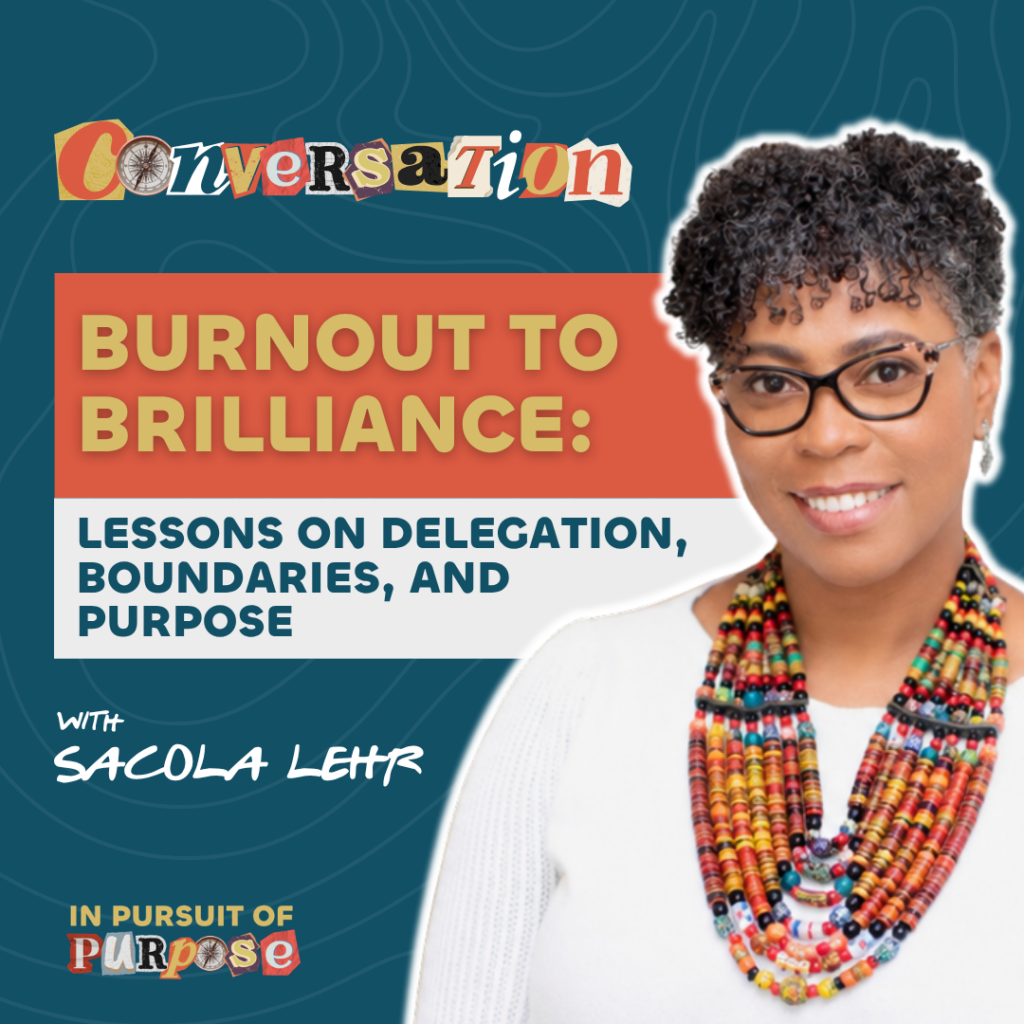
    I recently had the opportunity to sit down with Chase Friedman on the In Pursuit of Purpose podcast. We had an incredibly honest conversation about the “messy middle” of entrepreneurship, the origins of our drive, and how we can finally stop treating our fluctuating demands as personal failures.

    The Origins of the Hustle

    During the episode, Chase asked me a profound question: Where did the need to be this “boss babe” stem from?

    To answer that, I had to look back at my childhood. My early years shifted rapidly from stability to a single-parent home, to low-income housing, and eventually to homelessness. I remember the hollow feeling of opening a refrigerator and finding absolutely nothing inside.

    As a teenager, I made a vow to myself. I decided I would hustle tooth and nail to ensure my refrigerator was always full. I would never go without. That survival instinct pushed me to start working at sixteen, to grind through college, and to constantly bring my A-game.

    But survival mode is not a sustainable business strategy. When we operate out of scarcity, we take on projects that drain us and clients that do not align with our vision. We carry the burdens of our families, our colleagues, and society on our backs, secretly wondering, Who is going to show up for me?

    Redefining Success: Wellbeing is Wealth

    Society rewards output. It rewards production. We are taught that if we are not constantly producing results, we are failing. That is a lie.

    You can have a successful life and career without the crushing weight of chronic stress. You do not have to multitask to the point of dropping the ball on the things that truly matter. Real life is full of fluctuating demands there will be seasons of intense work and seasons that require deep rest. Acknowledging this rhythm is not a failure; it is the essence of true work-life harmony.

    As I told Chase on the podcast, my purpose in this season of life has shifted. Today, my wellbeing is my wealth. If I do not take care of my physical, emotional, and spiritual health, I surely cannot show up for my family, my team, or my clients.

    The PRONE to Power Framework

    This realization is what birthed my book, Harmony Hustle for Women. It is a guide written from the messy middle, designed to help you take burnout and turn it into brilliance. At its core is the PRONE framework, a compassionate approach to finding synergy in your daily life:

    •P — Prioritize: Not everything that is urgent is important. Learn to identify what truly moves the needle in your current season.

    •R — Rejuvenate: Your body will tell you when enough is enough. Listen to it. Step away, take a breath, and refill your cup.

    •O — Organize: Get your goals out of your head and onto paper. You do not have to accomplish everything at once.

    •N — Navigate Boundaries: Learn the art of delegation. Allow your team to shine in their own brilliance so you can shine in yours.

    •E — Empowered: Step into your leadership with humanity, empathy, and grace for others, and most importantly, for yourself.

    Filling Your Cup

    Author Iyanla Vanzant often talks about the concept of the cup. What is in the cup is for you; what is overflowing from the cup is for everyone else. For too long, women have been pouring from an empty cup, scraping the bottom just to give a little more to those around us.

    It is time to change the narrative. It is time to embrace a rhythm that honors our humanity.

    If you are tired of chasing someone else’s version of success, I invite you to listen to my full conversation with Chase Friedman on In Pursuit of Purpose. And if you are ready to master the art of thriving in both life and career, pick up a copy of Harmony Hustle for Women at https://sacolalehr.com/harmony-hustle-for-women/

    Let’s throw out the boss babe manual and start building lives of true purpose, prosperity, and peace of mind.

    SaCola Lehr is the author of Harmony Hustle for Women: Master the Art of Thriving in Life and Career and host of the Work It, Live It, Own It podcast.

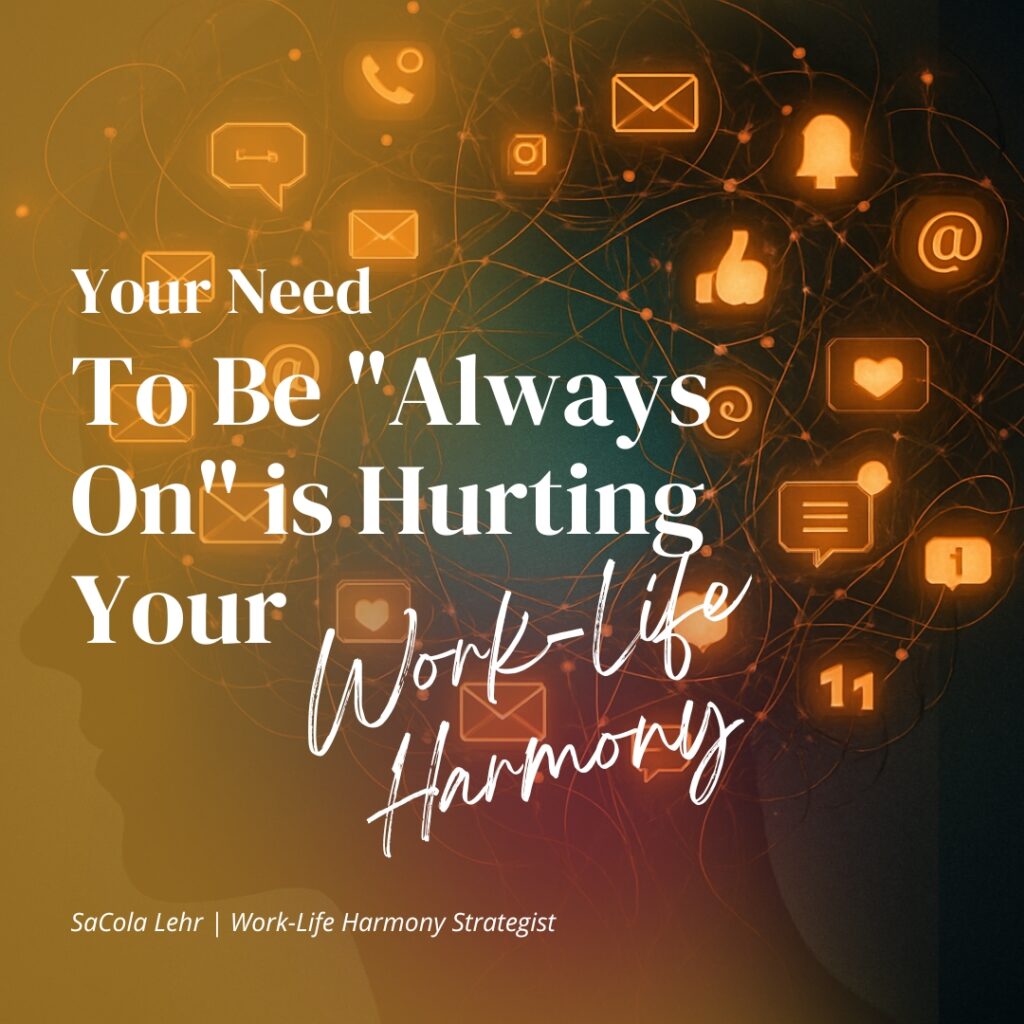
  • The Silent Burnout Trap: Why Your Need to Be “Always On” is Hurting Your Work-Life Harmony

    It’s Time to Power Down

    We live in the age of the perpetual ping.

    From the moment we wake up, our devices are screaming for our attention: Slack pings, email notifications, group texts, and the endless scroll of social media. We’ve been conditioned to believe that constant responsiveness is a sign of dedication, professionalism, and even love. If you’re not answering that email at 10 PM, are you truly committed? If you don’t reply to that text instantly, do you even care?

    This pressure to be persistently available is more than just a modern inconvenience; it’s a deeply damaging habit that is quietly draining your emotional battery. In this powerful installment of the “Suck It Up, Go It Alone” series, we’re unpacking why this need to be “always on” is not serving you, and how you can take brave action to reclaim your peace.

    The Cause of Your Hyper-Responsiveness

    The truth is, this isn’t just about technology. For many of us, the need to be constantly available is deeply rooted in our past.

    Think back. Were you the child who smoothed over tension, anticipated everyone’s needs, or felt responsible for keeping the peace? For those who grew up feeling they had to earn love or prove their value through their helpfulness, being needed became an identity.

    This is the Identity Trap: the dangerous, subconscious belief that says, “If I’m not available, I’m not valuable.”

    Let me be clear: Your worth is not tied to how quickly you respond or how many fires you put out. That survival strategy may have served you well as a child, but as an adult, it is an emotional drain that is leading you straight to exhaustion. You are valuable, period. Your availability is a choice, not a measure of your worth.

    Burnout Disguised as Dedication

    When you are constantly responding, checking, and anticipating, your nervous system is trapped in a perpetual state of “alert mode.” It never gets a break.

    This hyper-vigilance is the unseen cost of constant availability. It chips away at your peace of mind, manifesting as:

    • Irritability and Fatigue: You’re too wired to rest, and too tired to be present.
    • Resentment: You start to resent the very people you’re trying to care for and serve.
    • Emotional Exhaustion: You are the emotional glue for everyone your spouse, your kids, your parents, your team and the weight is crushing.

    We often label this constant state of “on” as dedication, but I want you to recognize it for what it truly is: burnout disguised as dedication. For some, this is even a trauma response, a hyper-awareness carried into adulthood from homes where peace was conditional on behavior.

    It’s time to stop being addicted to the chaos and start prioritizing your well-being.

    Let’s Reclaim Your Energy and Peace

    The good news is that you can unlearn this habit. You can reclaim your time, your energy, and your peace without losing your impact. It takes brave action, but the reward is a life lived in harmony, not survival mode.

    Here are four practical strategies you can implement today:

    ActionStrategyThe “Why”
    1. Set a Tech BoundaryTurn off all notifications outside of work hours. Create “no phone zones” during dinner, family time, or personal rest.To give your brain and nervous system a much-needed break from constant pings and demands.
    2. Communicate Your AvailabilityClearly state your response times. Example: “I check emails three times a day,” or “My cut-off time is 6:30 p.m. for family time.”People will respect your boundaries when they are clearly communicated and consistently enforced.
    3. Create Micro-Breaks to ResetImplement 5-minute deep breathing or stretching breaks, or a 30-minute “just sit, just be” ritual after work.These small, intentional pauses calm your nervous system and restore focus, preventing the buildup of stress.
    4. Remind Yourself of the TruthInternalize the truth: You are allowed to rest, and you are allowed to be unavailable.The world will keep spinning. Your value is inherent, not conditional on your responsiveness.

    People who love and respect you will understand your need for boundaries. When you clearly communicate your availability, you teach others how to treat you, and you give yourself permission to power down.

    The Takeaway: Persistent availability is a silent burnout trap. By taking these brave actions, you can stop trading survival mode for strategies that help you truly thrive in your career, life, and everything in between. You are allowed to rest. You are allowed to be unavailable. And the world will keep spinning.

    Listen to the full episode of Work It, Live It, Own It for a deeper dive into this topic